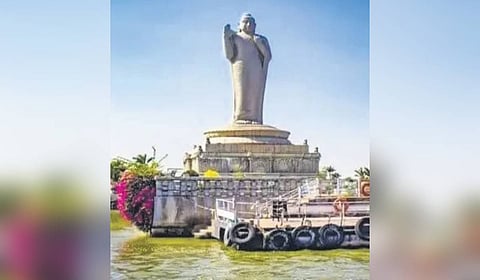

HYDERABAD: Once the pride of Hyderabad and later a symbol of urban pollution, Hussainsagar lake is poised for another major leap in its long journey of restoration.
In a fresh move to tackle algal blooms, persistent foul odour and declining water quality, the Hyderabad Metropolitan Development Authority (HMDA) proposes to introduce an advanced bioremediation process using enzyme solutions and biochar-based Bokashi balls.
For many years, Hussainsagar has been battling with sewage inflow, nutrient overload and industrial waste. These pollutants triggered massive algal bloom, which not only released foul odour but also suffocated the lake by reducing dissolved oxygen (DO) levels. Despite several rounds of bioremediation, the lake still required continuous oxygenation and remediation to maintain water quality.
The HMDA will take up the bioremediation of the lake by adding enzyme solutions with Bokashi balls made by using Biochar. The bioremediation of the lake by adding enzyme solutions with Bokashi balls is aimed to reinstate the natural conditions in the lake. HMDA will utilise proven technologies with regard to in-situ treatment of lake using bioremediation to remove algal blooms and minimise the odour generated from the lake for next two years by engaging an agency.
The major objective of the project is to reinstate the natural ecosystem with an emphasis on reduction of algal bloom thereby minimising foul odour by improving the water quality in terms of increasing the dissolved oxygen (DO) level. Besides cleaning of the lake water, the process is aimed to aid in restoring the natural ecological balance of the water body.
Sources said that the the process adopted for remediation of the water body would be a biological method or blend of biological process with mechanical/chemical processes. Removal and prevention of algal bloom and odour in the lake using in-situ bio remediation would have systems based on the aerobic/oxygenation and bio-augmentation.
HMDA has taken up the Hussainsagar Lake and Catchment Improvement Project (HCIP) with financial assistance of JICA in order to bring the lake to its original/natural glory. As a part of the project, HMDA carried out activities like diversion of sewage inflows, STP’s to discharge high quality of treated effluent in the lake, nala improvements in the catchment, etc. after completion of HCIP in the year 2013, the lake water quality has been consistently improving and showed a change in the improvement of DO.
The BOD values have also shown a considerable improvement after completion of the above interventions.
The intervention was carried out to arrest the algal bloom, foul smell and improvement of DO for the last seven years through various agencies on bio remedial basis.
During the interventions, there is a significant and consistent improvement in the water quality of the lake in addition to the reduction of the foul smell and DO was found to be more than 4.00 mg/l and BOD is ranging from 30 to 36 mg/l. In continuation of the ongoing remediation the request for proposal is aimed for bioremediation of the lake by adding enzyme solutions with Bokashi balls made by using biochar for minimising algal bloom formation and odour in the lake, they added.
The intervention shall consists of designing and implementing remediation systems that will prevent foul smell emissions, algal growth and enhance DO as major objective in addition to improvement of water quality, sediment quality, reduce the concentration of the suspended matter (turbidity), increasing transparency of water, reduce the presence of the pathogenic bacteria, and so on. The treatment process shall not have adverse effects on the lake during the process or afterwards, they added.
