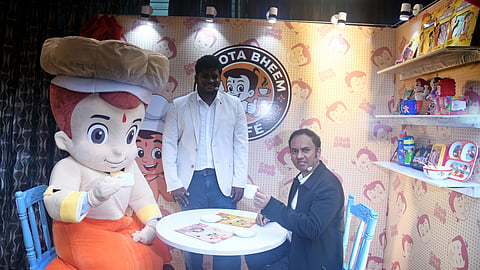

He entertained generations by creating one of the most beloved characters, with whom children instantly connect with. He made our childhoods truly memorable, and now, with the same passion and creativity, he brings that magic into a whole new space.
Rajiv Chilaka, founder and CEO of Green Gold Animation and the creative force behind the iconic universe of Chhota Bheem, is now venturing into the culinary world with a Chhota Bheem-themed café in collaboration with the EBG Group. In a conversation with CE, he talks about the café concept, the journey of Chhota Bheem, and how he continues to connect with new generations of children.
Tell us about the Chhota Bheem Café.
It’s been a long-held dream for us to expand beyond animation and merchandise. Bheem has been around for 17 years now and continues to hold the number one spot in the country. Even last year, it topped the ratings. Over the years, we’ve explored many ways to build on the brand. Inspired by global examples like Hello Kitty cafés, we wanted to create a similar experience here in India, where themed cafés based on characters don’t really exist. This will be the first of its kind. We’ve partnered with the EBG Group and are launching two cafés in Hyderabad, with plans to open 50 more each year across the country. We’re building a franchise model where each café will offer Chhota Bheem merchandise alongside its menu. The café format will also vary depending on the location — for example, airport cafés will be more compact, while those in malls and city centres will be larger and more immersive.
Where are you planning to launch the first café in Hyderabad?
We’ll be announcing it very soon. Our deal with the EBG Group is signed, and we’re planning to open our first café by December. We’re currently finalising the location — likely in Madhapur or the Financial District — after which we’ll begin the interior design and setup.
Can you take us through the journey of starting the Chhota Bheem show?
For Green Gold, the original inspiration was to create homegrown characters that Indian children could truly relate to. That was our primary goal. When Chhota Bheem premiered on April 6, 2008, it didn’t just transform Green Gold, it changed the entire animation industry in India. Before this, no Indian animated show had ever achieved that level of success. Our aim was simple: to build a deep cultural connection with Indian children. And it worked, almost every child in the country has grown up watching Bheem, no matter where they are from.
How are you planning to engage the new generation with the show?
If you look at shows like Cocomelon, they target preschoolers aged 2–6. Our main audience is slightly older about 4–8 years, but we’ve also created a younger spin-off called Mighty Little Bheem. It’s available on Netflix, where it consistently ranks among the top shows for preschoolers. In fact, it’s so popular that we now have a larger audience in North America than anywhere else. Today’s generation is very different. Earlier, simple storytelling was enough to keep children engaged. Now, they expect complex plots, meaningful lessons, and satisfying resolutions. With so many distractions around, holding their attention for even 15 minutes is a challenge. Thus, we’re expanding Bheem beyond television — the café. It is going to be a way for kids to physically connect with their favourite character. They want to touch, feel, and experience Bheem and this helps bring him closer to their hearts.
What challenges did you face while making the show?
The biggest challenge was constantly evolving Bheem’s story while staying true to what kids love. After COVID, we considered moving Bheem to a city setting to connect with urban audiences. But we quickly realised that children prefer the original Bheem. Kids’ minds are simple and clear, they like things to be black and white. Villains need to feel like villains. Grey characters can be confusing, so we keep the narrative straightforward. That said, characters like Kalia show growth and inner conflict, which children find relatable. He often struggles with making the right decision, which teaches kids that growth — in both mind and heart — is important. It’s okay to make mistakes, but staying on the wrong path is not. These kinds of lessons are woven into our stories.
What kept you motivated throughout the journey?
The unwavering love from children has been our biggest motivation. We’ve especially received immense support from our fans — many of them pick up Chhota Bheem comics even before they can read, holding them close to their hearts. Moments like that are deeply inspiring. Our team also draws inspiration from Bheem himself. Even during tough times in business, the character’s spirit keeps us going.
What message would you give to those who look up to you as an inspiration?
Nothing in life comes easy. Perseverance is everything. Keep trying until you succeed and above all, never give up.
