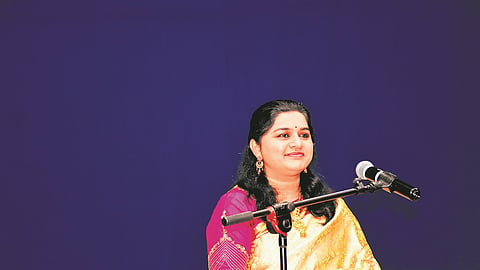

What began as a little girl’s devotion to her grandfather’s music in Telangana has today become an international movement for harmony and healing. Kalyani Mudumba, now based in Illinois, has turned Carnatic music into her medium of service — uniting cultures, empowering children, and spreading light through every note.
This year, her years of service were recognised with a proclamation from the mayor of Bloomington, Illinois — an honour rarely bestowed upon classical musicians, especially from the Indian diaspora. “The proclamation is a big honour, especially for Carnatic music,” she shares, adding, “They chose me because of the community service I’ve done through music. During the pandemic, I wanted to take Carnatic music to a different level — to make sure others benefit from it, not just my students.”
Born in Telangana, Kalyani began learning music at the age of three under her grandfather, Mudumbai Lakshmana Charya Swamy, and later trained with Singara Charya and Mythraeyee Mukundan. “My grandfather walked miles to teach music and never took a penny. His passion was beyond money,” she recalls. Though an MBA graduate, her calling lay in continuing his legacy. “My guru, His Holiness Chinna Jeeyar Swami ji, reminded me that my purpose wasn’t in business, but in music,” she adds.
Hyderabad shaped her artistic foundation. “People assume Carnatic music belongs only to Tamil Nadu, but Hyderabad, too, has deep roots,” she smiles, adding, “Whenever I perform, people ask if I’m from Chennai, and I proudly say, ‘No, I’m from Telangana’.”
After moving to the US in 2014, Kalyani re-established her Kalyani School of Music in Bloomington a year later. She began teaching by visiting students’ homes, ensuring inclusivity and personal connection. “Carnatic music enhances intellect and discipline,” she explains, adding, “But more importantly, it bridges cultures and creates harmony.” Her dedication earned her Guru Vandana Teacher Appreciation Awards in 2016 and 2017 from the Hindu Swayamsevak Sangh.
One of her deepest commitments is inclusivity. Kalyani works with neurodiverse children, adapting lessons for learners of all abilities. “Teaching children with speech or learning challenges gives me more exposure than teaching regular students,” she says, adding, “It teaches patience, empathy, and shows that music truly has no barriers.”
During the pandemic, she launched Sangeetha Yagna, a virtual fundraiser connecting students across the US and India. “Everyone was scared,” she recalls, adding, “I told my friends — start learning ‘Kriti’, pay whatever you can. It wasn’t about money, it was about connection.” The initiative collected $1,300 for Nethra Vidyalaya, a school for visually impaired children located in Hyderabad.
Her international fame continued in 2022 with her organisation of Ashtotthara Shatha Sankeerthana Archana, singing 108 songs in six different languages by students from Asia and North America, from which $7,000 was raised for the Hindu Temple of Bloomington; they subsequently received world records in the Asia Book of Records and Indian Book of Records.
“Temples are hubs of spirituality and culture. Supporting them felt essential,” she says.
In 2023, her concert Sundara Setu — a 90-minute performance for a 90-foot Hanuman statue in Houston — earned her two more world records. “It was symbolic,” she smiles, adding, “An offering of devotion and determination.” The following year, she organised Sanjeevani, a fundraiser for St Jude Children’s Research Hospital, where her students sang for healing. “I wanted them to know that giving doesn’t have to be huge — even small efforts matter,” she says.
Her consistent service caught the attention of Bloomington’s mayor, who had attended several of her events. “They were impressed that through Carnatic music, I could bring cultures together,” Kalyani says with quiet pride. “That’s the beauty of music, it transcends language, region, and religion,” she notes.
Despite her achievements — being the first Carnatic musician with records in both Asia Book of Records and India Book of Records — Kalyani remains humble. “When I think of the great legends, I still see myself as a beginner,” she says, adding, “Carnatic music carries India’s roots and soul. To understand India, one must listen to this music.”
As a teacher, she blends tradition with relatability. “Today’s generation wants logic. Once they understand the science and emotion behind the compositions, they fall in love with it,” she shares.
Beyond music, she writes under the pen name Kalyani Shyam, contributing to spiritual magazines and working on her first book about Carnatic music. Since 2016, she has also served as a judge for Illinois’ largest county fair, continuing her commitment to education and the arts.
For Kalyani, every note carries purpose. “Music has the power to heal, to unite, to inspire,” she says softly, further adding, “If my work can touch even a few lives, I feel my grandfather’s dream lives on.”
In every performance and every classroom, Kalyani Mudumba continues to prove that the ancient rhythm of Carnatic music still has the power to make the modern world sing in harmony.
