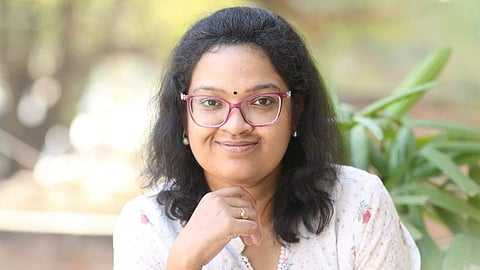

The art of storytelling has its own charm and beauty. Every time we watch a film, we marvel at how creatively a director brings each scene to life. Director Padmavathi Malladi, the mind behind Gandhi Tatha Chettu, a film that recently won a National Award for its lead child artiste, Sukriti Veni Bandreddi, has already made a mark with audiences. As the film and its team continue to receive accolades, CE spoke to Padmavathi Malladi about how she came up with the idea for the film and her journey in the industry.
Excerpts
Tell us about the journey of your film Gandhi Tatha Chettu.
The idea came from my friend Venkat Karnati, who is also a filmmaker. He once told me a simple line: a small boy plants a tree, grows up with it, and one day a boundary wall is built around that tree. I loved the thought and kept encouraging him to develop it into a film, but for a year he didn’t write a single word beyond that line. Eventually, I got frustrated and decided to write it myself. As I developed it, I thought, why not make the child a girl instead of a boy? Why not a granddaughter instead of a grandson? That’s how Gandhi became a girl, and from there the story blossomed into something beautiful. When I narrated it to Venkat, he said, ‘This is not my story anymore, it’s yours.’ I decided to take it up as a film. Of course, the journey wasn’t easy, it was rejected by almost 14–15 production houses and OTT platforms. But I was determined to make it at any cost. My best friend Sesha Sindhu Rao supported me, and together we raised the funds.
What challenges did you face while making Gandhi Tatha Chettu?
We managed to raise Rs 85 lakhs through crowdfunding, and that gave us the push to begin. Since this was a children’s film and an indie project, we weren’t aiming for commercial returns, we simply wanted to make it within the resources we had. We had no office, so my home became the office. Sindhu’s house, which was close by, became our audition space. We didn’t even have a food budget, so to cut costs, I would wake up early and cook for the entire team. That went on through the entire pre-production, and it was quite an experience! We shot in a small village with no nearby stores, so everyone had to adjust. Four to five people often shared a single room. Despite the constraints, everyone was cooperative. Thabitha ma’am never made any demands, and Sukumar sir only said, ‘If you need anything, let me know.’ He never even asked about resources. There was just one hotel in the area with two or three rooms. We would book one room for Thabitha garu and Sukriti, and the rest of us adjusted in another. It was a tough experience, but never painful, because the entire team’s spirit kept us going.
How did you manage to work with the team?
My team was very supportive, including the kids, they worked really hard. Since we had very few shoot days, we wrapped the film in just 25 days, but we prepared rigorously for two months. We held intensive workshops with the children so they would know their lines thoroughly. Working with the villagers was more challenging. Since we didn’t have junior artistes, we brought in locals and convinced them to participate. Some days they would show up, other days we would be out in the fields looking for them! Sound was another hurdle — if there was even the slightest disturbance, we had to retake. Eventually, the villagers understood the process. After a few days, the moment they heard my voice on the mic, they would pause their work and stay quiet, some even stopped washing vessels (laughs). We also shot during the rainy season, so sudden showers often forced us to pause and wait. Despite all this, the cooperation we received kept us going.
Were there any disagreements while shooting?
Not really, because we did script readings in advance, and the actors clarified their doubts beforehand. Chakrapani sir was wonderful to work with, his eyes are so expressive, and he brought an intensity to the role that was remarkable. He was very enthusiastic about his character. The kids, on the other hand, would get tired easily. We started shooting as early as 6 am, and by afternoon they would be exhausted. In the first few days this was a big challenge, but later we started giving them proper breaks — from 1 to 3 pm — so they could return fresh for the shoot. Planning around their energy levels was a bit tricky at first, but eventually, it worked out well.
What is your favourite scene from the movie?
One of my favourite scenes is the climax where Gandhi’s father touches her feet and cries. While writing it, I had tears in my eyes, because many times parents don’t really understand our struggles, especially as girls. They tend to be overprotective and believe it’s unsafe for us to step out and fight for something. They don’t always see the bigger picture, and that makes it harder for us to pursue what we want. Raghu did a brilliant job in that scene, and many people have spoken to me about it. Another powerful moment is when Gandhi falls down, helpless, and begins singing ‘Raghupati Raghav Raja Ram, Sabko Samathi De Bhagwan’. The other children join her, and suddenly the atmosphere changes. Everyone realises their mistake, everyone has their moment. Gandhi herself couldn’t do anything, but her faith and conviction moved others to stand with her and even nature seemed to respond, showing that it was being hurt too. On the day we shot that scene, we had only five minutes before we lost light. I told Sukriti, ‘We have just one take, you have to give it your all.’ I was nervous about whether she could pull it off, but the moment she screamed and sang, we all got goosebumps. When I reviewed the shot, I noticed that at the exact moment she cried out, a gust of wind swept through naturally, we didn’t create it. The way she sang, her voice and expressions, everything was perfect. That was the moment I felt she was truly meant to play Gandhi.
What kept you motivated?
Mainly, it was my urge to tell this story. From the moment I finished writing it, I felt a deep attachment to it. I strongly believed it had to be told — whether or not people watched it, whether or not it received recognition. For me, it wasn’t about the outcome — it was the story itself that kept drawing me back and motivating.
What made you choose Sukriti for the role?
Sukriti is truly deserving. Even though she is a child, she carries an innate purity that allowed her to interpret the character so beautifully. She had the huge responsibility of carrying the film on her shoulders, and she did it with grace and depth. Our film was screened at several festivals in Russia, and she even won a state award there. Thousands of children watched it and praised her performance. The National Award is like the ultimate recognition for her. We had completed censor in 2023 and initially thought of releasing then, but on Sukumar sir’s suggestion, we held back to take the festival route for about a year and a half. That year, there were many strong children’s films in competition, and it was tough. Though I always believed in her, I still had my fingers crossed. When the win came, it was such a special moment for us.
Any specific actor you want to work with?
There are so many! We have such incredible talent in the Telugu industry, and their work connects with audiences across the nation. Personally, I’m a huge fan of Jr NTR sir and would love to work with him someday. Venkatesh garu is another actor I deeply admire and would be thrilled to collaborate with.
What is the one message you want to share with indie filmmakers?
Indie cinema demands a lot of patience. My only advice is, be patient. Trust your story, trust the process, and it will happen.
What are your upcoming projects?
Right now, I’m researching a subject that is a socio-political drama. It requires a lot of groundwork, but I strongly believe that stories must carry a sense of responsibility and purpose. I always ask myself, ‘Why am I telling this story?’ At the same time, someday I’d love to do a complete entertainer. My biggest inspiration is Singeetam Srinivasa Rao sir, he has done it all, from National Award-winning films to commercial cinema, without boundaries. That’s the kind of filmmaker I aspire to be.
