
HYDERABAD: A chance discovery in Kodad village has turned into one of the most significant breakthroughs in the study of medieval south Indian history, particularly the Kakatiya past. In April, nine sets of copper plates belonging to the Vengi Chalukya dynasty (9th–10th centuries CE) were unearthed at a Muslim graveyard in Telangana. Each set carries detailed records of royal grants, temple endowments and dynastic genealogies.
While the inscriptions primarily illuminate the rule of the Vengi Chalukyas, they also contain references to the ancestors of the Kakatiyas, who would later rise to imperial glory in Orugallu (Warangal). This makes the finds a milestone in reconstructing the dynasty’s formative years.
The plates, inscribed in Sanskrit using Telugu script, provide the earliest known genealogical and historical references to the Kakatiyas. The earliest of the plates dates back to around 890 CE. According to K Munirathnam, director (epigraphy), Archaeological Survey of India, they push the recorded history of the dynasty back by at least a century. “The nine sets of copper plates from Kodad are more than mere inscriptions; they are windows into forgotten chapters of the Kakatiya story,” he told TNIE.
Early Kakatiya history has been pieced together from copper plates such as the Mangallu grant of Vengi Chalukyan prince Daanaarnava (c. 956 CE) and stone inscriptions like the Kazipet Dargah inscription (c. 1090 CE) of Beta II, the Thousand Pillar Temple inscription (1163 CE) of Rudradeva, and the Bayyaram Tank inscription (early 13th century CE) of Mailamba, sister of Ganapatideva. Literary works such as Prataparudrayashobhushanam also offered limited references. The Kodad plates consolidate this evidence, firmly situating the dynasty’s roots in the 9th century.

Where does ‘Kakatiya’ come from?
The origins of the name have long been debated. Some scholars trace it to a place, while others argue it derives from Kakati, a form of Goddess Durga, the dynasty’s tutelary deity. A few even associate it with a Jain goddess. Opinions also differ on geography, with identifications ranging from Belagavi in Karnataka and Maharashtra to Chhattisgarh.
Professor SS Ramachandra Murthy, in Inscriptions of the Kakatiyas of Warangal (Indian Council of Historical Research, 2011), noted: “The correct interpretation of Kakati, which lent its name to the dynasty of the Kakatiyas, has to await future evidence.”
The Kodad plates, however, appear to solve this puzzle. They contain the earliest references to the Kondapalli region and the village of Kakarti, firmly placing the dynasty’s origins in Telugu land. “The plates prove beyond doubt that the Kakatiyas were key players in the Kondapalli region before they shifted to Warangal,” said Munirathnam.
The records identify Kakarti village as part of Kondapalli Visaya, an administrative subdivision akin to today’s mandal or district. For comparison, inscriptions mention Anumakonda Visaya, corresponding to areas around present-day Warangal.
Kondapalli, the cradle of the Kakatiyas
The plates repeatedly reference Kakarti in the Vengi mandala of Kondapalli visaya, where Kakatiya ancestors built or endowed temples such as Sakaleshvara, Bijjeshvara and Gundeshvara. These details firmly establish Kondapalli and the nearby Bojjaprolu region as the dynasty’s early homeland. While Gundayya looked after Kondapalli Visaya, Betiya handled the affairs of Bojjaprolu, the plates revealed.
Nelakondapalli in Khammam district lies about 15 km from Kodad, where the plates were unearthed. Researchers suggest Kakarti may once have existed in this vicinity. “Efforts are underway to identify the precise site of Kakarti village,” said Munirathnam.
Historian D Suryakumar, however, cautioned that the inscriptions themselves make no direct mention of location. “Its identification is particularly challenging, as none of the temples referred to have yet been traced,” he said.
Ramachandra Murthy also pointed out that visaya divisions rarely occur in Kakatiya records, while Kondapalli nadu, mentioned in the Tripurantakam inscription (1185 CE), lay in the present-day Krishna district of Andhra Pradesh.
Archaeologist and sthapathi (temple architect) E Sivanagi Reddy added that Kondapalli visaya should not be confused with Nelakondapalli. “Instead, I believe it was closer to Vijayawada, with its extent reaching up to Nandigama. This suggests Kakarti village may have been located somewhere within this stretch,” he noted.
From feudatories to empire builders
While it was already known that the Kakatiyas began as feudatories under the Rashtrakutas and Kalyan Chalukyas, the plates show that they later served under the Chalukyas of Vengi as well, gradually rising into powerful regional lords before asserting independence in the 12th century.
At their peak, under rulers like Rudradeva (1158–1195 CE), Ganapatideva (1199–1262 CE) and Rudramadevi (1262–1295 CE), they consolidated much of Telangana and Andhra Pradesh and extended into Karnataka and Tamil Nadu. The last great monarch, Prataparudra II (1295–1323 CE), eventually fell to the armies of the Delhi Sultanate.
The Kodad plates revealed that before rising to sovereignty, the Kakatiyas also owed allegiance to the Vengi Chalukyas at some point of time. Their subordinate beginnings are echoed in the Mangallu grant, which mentions chiefs Rashtrakuta-Gunda and Rashtrakuta-Eriya. Historian PV Parabrahma Sastry even argued that the “Rashtrakuta” suffix may indicate a Rashtrakuta lineage.
“The Kodad plates highlight how a family of feudatories, through valour and cultural patronage, laid the groundwork for one of the greatest dynasties of south India,” said Munirathnam.
What the plates reveal
The inscriptions trace the lineage to early ancestors such as Saamanta Vetti and Vigraha Vetti, and a succession of chiefs — Gunda I, Gunda II, Gunda III, Erra and his three sons Betiya, Gundayya and Gonaka — figures otherwise shadowy in history but now recognised as progenitors of the line.
ASI director K Munirathnam said he is uncertain about the three Gundas, suggesting there may have been only two, though further clarity is needed.
The second set of plates (918 CE, coronation grant of Vengi Chalukya ruler Vikramaditya II) contains the earliest genealogical reference to the Kakatiyas, directly naming the Vetti family within Chalukya political networks. They also highlight the martial contributions of Kakatiya chiefs.
In one dramatic episode, Gundayya, grandson of Gunda, is credited with killing the usurper Taalapa in battle, restoring Vikramaditya II to his throne. For this service, he and his family were rewarded with village grants.
The plates also record religious endowments. Gundayya’s wife Lokanavva built the Bijjeshvara temple, while Lokamamba, daughter of a Pennatavadi chief, constructed the Gundesvara shrine. Other inscriptions mention land grants — such as Envuru and Locheruvulu — given to Kakatiya chiefs and their kin to support temples, Brahmins and worship. These details show that the Kakatiyas were deeply rooted in temple culture long before their rise as sovereigns.
Bridging Vengi Chalukyas and Kakatiyas
The Vengi Chalukyas ruled coastal Andhra between the 7th and 11th centuries CE. As their feudatories, the Kakatiyas gained prestige, resources and military experience — building armies to support their overlords. This relationship laid the foundation for their eventual independence, mirroring patterns seen across India where feudatory families grew into sovereign powers as empires weakened.
The Kodad plates remind us that dynasties do not emerge in isolation. The Kakatiyas’ later achievements in Warangal — forts, temples, irrigation tanks and cultural patronage — were built on foundations laid centuries earlier in Kondapalli.
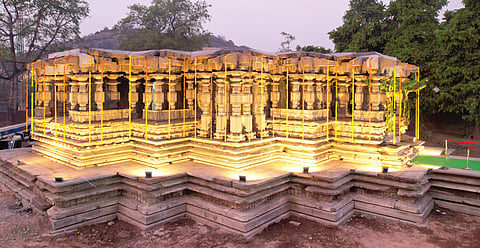
Today, their legacy endures through monuments like Warangal Fort and the Ramappa temple. With the Kodad discovery, that legacy gains a deeper and more continuous historical foundation stretching back to the early medieval period.
Munirathnam noted, “No longer do the Kakatiyas appear suddenly on the stage of history as rulers of Warangal. Instead, they emerge organically from the socio-political milieu of the Vengi Chalukyas — their roots firmly planted in Kondapalli, their story stretching back to the 9th century, and their legacy enduring for centuries thereafter.”
Roots revealed
Nine sets of copper plates were unearthed in a Muslim graveyard in Kodad in late April.
The second set of copper plates (918 CE) contains the earliest genealogical reference to the Kakatiyas, pushing their recorded history back by at least a century, according to K Munirathnam, ASI director (epigraphy).
By recording that three temples were built by the dynasty’s early chiefs in the village of Kakarti, the plates appear to settle the debate over the origin of the name Kakatiya.
The plates locate the village of Kakarti in Telugu land, within Kondapalli visaya. Earlier, scholars had proposed sites in present-day Karnataka, Chhattisgarh or Maharashtra. Whether Kakarti lay near Nelakondapalli in Telangana or closer to Kondapalli in Andhra Pradesh remains unresolved. “Efforts are underway to identify the precise site of Kakarti village,” said Munirathnam.
The plates show that the Kakatiyas were already prominent feudatories by 918 CE.
Women of the family, such as Lokanavva, played active roles in temple-building, long before Rudramadevi rose to power.
The plates also mention tanks like Vittiyarattodla, Kodieri gunta, Kadayala gunta, Gummiyala gunta and Kondapalli tank, underlining the Kakatiyas’ emphasis on irrigation and water management.
Patronage of Kalamukhas
Earlier inscriptions had shown that later Kakatiya chiefs, such as Beta II and Prola II (11th–12th centuries), were patrons of the Kalamukha sect of Shaivism. The Kodad plates push this association further back, showing that Kakatiya chiefs and their families supported Kalamukha preceptors and temple traditions from the very beginning.
Three Gundas, ‘equal in valour to the 3 Ramas’
The Bayyaram Tank inscription offers a glimpse into the early lineage of the Kakatiyas. It records that Venna, a descendant of the Durjaya family, ruled from Kakati, giving the dynasty its name. His successors—three generations of rulers named Gunda—were eulogised as being equal in valour to the “three Ramas”: Parasurama, Dasaratha Rama and Balarama. This poetic comparison not only highlights their martial prowess but also reflects the practice of linking local chiefs to epic heroes.
Rise of Rudramadevi amidst revolt
Though Ganapatideva had no male heir, he had two daughters. In 1262 CE, Rudramadevi ascended the throne under the male name Rudradevamaharaja. Despite revolts by her cousins that kept the political situation tense, she quelled the rebellion with the support of her generals.