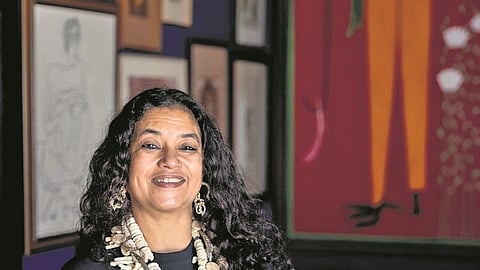

Remember the days when we were asked to draw anything we liked in school? We always drew a tree, mountains, clouds, and a house. Indeed, India’s art is inseparable from its landscapes — its rivers and forests, myths and rituals, textures and pigments drawn from the soil itself. A new exhibition, Affordable Art Show, curated by Srila Chatterjee, brings this deep connection between art and the natural world into focus. Opening at Gallery 78, Silpa Hills in Khanamet, the show invites audiences to step into a vibrant journey through the country’s visual traditions.
From the Thangka and Buddhist art of Ladakh to Rajasthan’s Phad and Pichwai scrolls; from Bengal’s Shola craft and Kalighat paintings to the painted languages of Gond, Warli, and Bhil in Central India; from the Sohrai paintings of Jharkhand to the coastal imageries of Goa and Kerala — the exhibition gathers together practices rooted in distinct geographies, yet bound by a shared reverence for nature.

“What inspired me was my life-long draw to discovery, visiting makers, learning crafts, and encountering folk artists in different places. The diversity comes naturally: different regions offer different techniques, materials, and mythologies; drawing them together helps us see both their uniqueness and shared roots,” Srila reflects.
The exhibition’s central theme of nature is not limited to visual motifs. “I believe the theme of nature shows up in both explicit imagery — flora, fauna, landscapes, myths — and in materiality, whether natural dyes, organic fibres, or traditional pigments,” Srila explains, adding, “Even our contemporary artists reinterpret nature — often in response to climate, land use, and local ecology. By juxtaposing traditional depictions with modern interpretations, the theme becomes connected to much more than the decorative.”
Rather than forcing a balance between heritage and modernity, Srila allows the artworks to speak for themselves. “We don’t aim to strike any particular balance. We choose work we love and artists we respect, and fundamentally we believe all this work can coexist without question,” she says.
That coexistence becomes most apparent in works that gently stretch tradition. “A pattachitra artist moving from long scrolls to intimate panels for contemporary homes, or a folk painter addressing climate change through a centuries-old vocabulary. Reminds us that these practices are not static; they evolve with social, ecological, and spiritual insight,” she notes.
Srila is also clear about one of her guiding principles: accessibility. “Art should not be a privilege,” she emphasises. “We want people to feel comfortable walking into a show and knowing there are works within reach, whether they are first-time collectors or long-time patrons. Accessibility encourages discovery, appreciation, and collecting that grows over time. At the same time, fair pricing ensures artists are paid ethically without pushing their work beyond the reach of most people.”
For Srila, every exhibition is an evolution — new work, new artists, new conversations. This one, she hopes, will leave visitors with more than admiration. “We hope they walk away seeing art not as something remote or decorative, but as something alive and intertwined with people’s lives, histories, and ecosystems. Most of all,” she says with a smile, “I hope they carry with them joy!”
Open and free to all, the three-day exhibition (Sept 19, 20, 21) at Gallery 78 is more than a showcase of India’s rich traditions, it is an invitation to experience how art, nature, and people remain deeply and beautifully entwined.