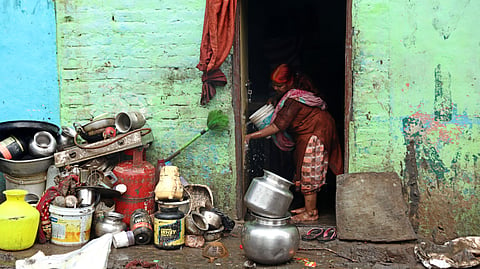

HYDERABAD: A day after the swollen Musi River inundated several localities and wreaked havoc, floodwaters began to recede across most areas on Sunday, bringing partial relief to residents.
Several riverbank colonies, particularly around Chaderghat, remained blanketed in mud and slush, with heaps of waste scattered across lanes and inside homes. Essential household items such as furniture, clothes, utensils, and electronics were left caked in silt as families struggled to clean their flood-hit dwellings.
In response, GHMC launched massive cleanup operations in the affected pockets. Sanitation workers were deployed to remove debris, garbage, and silt, while disinfectants were sprayed to prevent outbreaks of vector-borne and waterborne diseases. Officials said the drive would continue until all flood-hit zones are restored to normalcy.

At Moosarambagh bridge, workers began dredging and clearing the riverbed, while pump sets were pressed into service to drain stagnant water from low-lying areas. Large-scale disinfection drives were also carried out at the Mahatma Gandhi Bus Station (MGBS) and adjoining neighbourhoods. In addition, food was distributed to affected families, and special medical teams were stationed in vulnerable colonies to provide healthcare support and safeguard public health.
Beyond government efforts, NGOs have stepped up to support affected families. Terminate Hunger, a five-year-old NGO, has been actively providing relief. Founder Mohammed Imad Ali told TNIE that as residents slowly return from rehabilitation centres to begin cleaning their homes, volunteers are ensuring food and water supplies.
“We have supplied food to nearly 2,000 people since Saturday. On Monday, we will distribute clothes to affected families,” he said. Currently, two to three rehabilitation centres are operating in the flood-hit zones.
Normalcy returns at MGBS
Meanwhile, normalcy returned at MGBS on Sunday after floodwaters from the overflowing Musi River receded, allowing bus services to resume. The sprawling terminal, which was submerged on Saturday, was cleared of mud and debris overnight to facilitate passenger movement.
Speaking to TNIE, TGSRTC Regional Manager (Rangareddy) J Srilatha said restoration efforts were taken up on a war footing. “Sanitation works began on Saturday night and continued till Sunday morning. Services resumed from 11 am,” she said.
Explaining the disruption, she noted that the retaining wall was damaged, leading to the inundation of MGBS. “As soon as the station was flooded, we diverted buses to peripheral points such as Uppal, Aramgarh, and LB Nagar. Passengers with reservations were informed of the change in boarding points through SMS. However, those arriving at MGBS via metro were impacted and had to postpone their travel,” she added.
By Sunday, more than 2,000 scheduled services were operated, with the terminal once again bustling with passengers, many of whom had delayed their journeys a day earlier.
Meanwhile, anticipating passenger rush, TGSRTC continued to operate services from alternative boarding points, including Aramgarh, Dilsukhnagar, LB Nagar, Uppal, and Jubilee Bus Station. Officials advised commuters with prior reservations to head directly to these designated locations to avoid confusion.