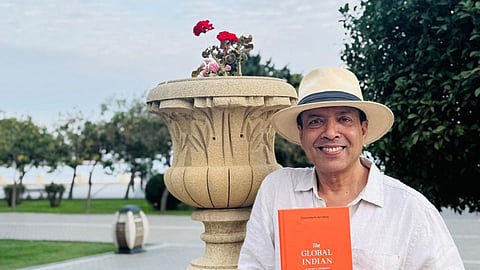

Thousands of Indians migrate abroad every year, some as students, others as professionals, many as NRIs. But only a few make the leap to become what Xavier Augustin calls Global Indians. An entrepreneur, storyteller, and founder of Y-Axis, India’s largest immigration and career consultancy, Augustin has spent decades guiding Indians through their journeys overseas, helping them navigate opportunities in education, work, and migration. With a deep interest in identity, aspiration, and global mobility, he now turns his attention to exploring what it truly means to be a Global Indian. His new book, The Global Indian: A Hero’s Journey, traces this transformative path, one that takes Indians beyond borders and brings them back changed.
Excerpts
What inspired this book?
I liked the idea of defining who a Global Indian is. It sets an aspiration for Indians, like a goalpost — whether in career or in life. It’s about what you could potentially become. A Global Indian is not the same as an NRI. It’s someone who follows their own calling — perhaps to London, Paris, or the US — answering a call to adventure. It’s essentially a hero’s journey, which always has three stages: separation from home, initiation in a new and unfamiliar environment (facing challenges like language, loneliness, food, or climate), and finally, transformation. Everyone who stays the course changes profoundly. Then, they return home with something they’ve learned, like returning with the elixir. This journey of separation, initiation, transformation, and return is what defines a Global Indian. I believe most Indians should embark on such a journey, because that’s how great things are accomplished. Look at BR Ambedkar, Mahatma Gandhi, Narayana Murthy, Rishi Sunak, or Dr Devi Shetty — who wrote the foreword for this book; they all went through this global journey.
Were you particular about choosing the people profiled in the book?
Yes. There are 12, and they’re my favourites because they represent their times. Different eras create different kinds of people. For example, Gandhi became who he was because of the freedom struggle. After independence, we needed nation-builders; people who created institutions like the Bhabha Atomic Centre, ISRO, or Amul, or those who drove the Green Revolution. Today, we’re in a new era of innovators — Indians in AI, space, and global geopolitics. But all of them share one thing: a big idea. Ambedkar’s was about justice, liberty, and equality. Gandhi’s was non-violence as an instrument of change. Others, like Narayana Murthy, held on to their vision and built at scale. Take Kalpana Chawla, she was a small-town girl from Haryana who dreamt of space. The odds of becoming a NASA astronaut were minuscule, yet she held on to her dream and, in doing so, pushed not only her own boundaries but also the boundaries of what it means to be Indian. All these individuals have contributed to building the brand of India through courage and resilience.
What can today’s youth learn from this journey?
We live in a VUCA world — volatile, uncertain, complex, and ambiguous. Life, career, and travel decisions are constantly shifting. The lesson is that young Indians must prepare to navigate this uncertainty, especially amid today’s geopolitics. It has become more challenging. Would you abandon plans to go to the US because of tensions with India? Perhaps those tensions will fade, and they’ll become close allies again. Maybe the UK will open up. Maybe more people will start learning Japanese because Japan is becoming more welcoming. Finland, Germany, and Korea all want Indian students. When one door closes, several others open because the world ultimately needs talent.
Does being Indian abroad feel different now compared to a decade ago?
There are two types of Indians. Those with credibility and qualifications, the meritorious Indians, don’t face problems. They will always find employers who need them. Those who entered countries through other means are usually the ones complaining. Even NRIs can struggle because they’re entrenched: their children are in school, they have mortgages, and returning to India is not easy. For them, it’s more challenging. Those without qualifications or who’ve lost jobs and visas will face difficulties.
Does this recalibration create opportunities for new talent?
Absolutely. China, for example, has announced a K visa. The world is recalibrating. Many countries previously admitted people who weren’t the right fit; like students exploiting loopholes. Now, they’re aligning the right talent with the right opportunities.
If you had to sum up your book with one takeaway for readers in India and abroad, what would they be?
For readers in India: 'Bano Global Indian'. Embark on your hero’s journey.
For readers abroad: Do something meaningful and purposeful. Create an impact. Come back and make a difference.
