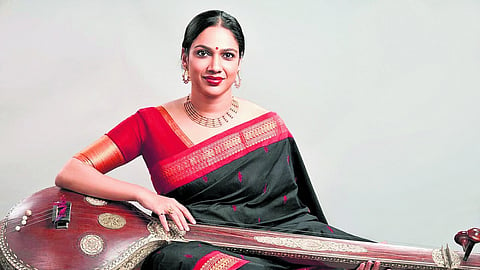

The excitement was unmistakable as singer Gayatri Asokan was back in Hyderabad after a long gap. The city holds a special place in her heart, not just for its warmth but for its deep-rooted love for poetry and ghazals. Having last performed here about a year and a half ago, she recently performed at the Gayaki, Gat, Ghazal at Taramati Baradari Resort, which brought her closer to an audience she describes as deeply appreciative and culturally attuned.
Speaking about the city, Gayatri says Hyderabad has always responded generously to her music. “Hyderabad is always special because of its thriving Urdu culture here, people love ghazals, and I’ve always gotten a really wonderful audience here,” the singer shares. She also expresses gratitude to the organisers for making the concert possible and shares her excitement about sharing the stage with her husband, musician Purbayan Chatterjee. “We rarely do shows together. He does his classical concerts, and I do my ghazal concerts, so this is one of those few occasions where we perform together,” she says, calling it a rare and joyful collaboration.
Before stepping on stage, preparation remains key. Gayatri explains that no matter how unpredictable travel schedules get, warming up her voice is non-negotiable. “For me, it is basically about warming up my voice, which is a must. Even when flights are delayed and routines get thrown off, I adjust and make do with whatever time I have. Before going on stage, I warm up and do a little pranayama, as it helps my voice and calms me down,” she says.
Reflecting on her journey, Gayatri recalls how music became her calling much later in life. “I was born into a doctor’s family, with both my parents being doctors, so there was no early clarity about pursuing music professionally, unlike those born into musical families who receive mentorship from a young age. For me, this realisation came much later, after completing my bachelor’s in English, when I was singing with local bands and began loving Hindustani music. In 1996, I took a leap of faith and went to Pune to learn it in the gurukul tradition. It was a radical decision in Kerala at that time, yet my parents fully supported me, and that conviction truly paid off,” she notes.
Over the years, her ability to move between genres has shaped her artistry. “It’s really helped because, during college, I sang in western music bands, which made me realise how important it is to listen to all kinds of music without being opinionated about one school being superior. That exposure helped me become more adaptable. Although I was trained in Hindustani classical, playback recordings in Kerala pushed me out of my comfort zone and shaped my voice. Working across genres, including film music and ghazals, taught me how to approach the mic differently, helped me avoid sounding archaic, and eventually led me to focus on ghazals while shaping a unique, commercially viable voice,” she explains.
Gayatri believes Hyderabad’s music scene has immense potential but needs more public platforms. “I feel it is great, but we need more public shows because the audience for ghazals is strong. I look forward to greater appreciation for poetry and lyrics, as this is our heritage and culture. Cities promote art well, so Hyderabad should organise more classical and semi-classical shows, make them public, offer student discounts, and attract young audiences, which is the need of the hour,” she narrates.
Looking ahead, Gayatri is focusing on original ghazals and new compositions. “There are ghazal singles coming up, and I am publishing an album this year, while focusing on original ghazals by poets, composing more, performing in North India, and hoping the South opens up to ghazal concerts as well,” she concludes.
