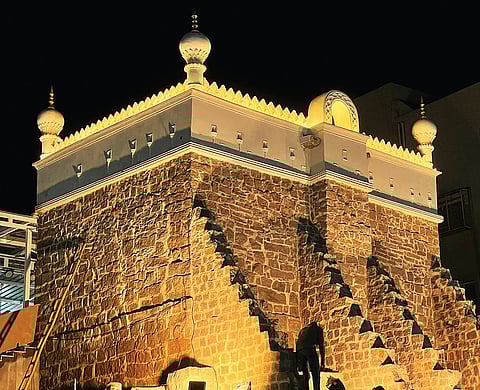

HYDERABAD: From cracked walls and a collapsed roof to restored arches and rising domes, the Qutb Shahi Mosque in Shaikpet now stands as a testament to collective resolve.
Fragile and fading for years, the centuries-old structure has been revived through a year-long conservation project supported under CSR funding and contributions pooled by the local community. The mosque is set to reopen on February 15.
Built during the rule of the Qutb Shahi dynasty, the mosque embodies the hallmarks of the era — high Persian-influenced pointed arches, slender decorative minarets and pillarlets, bulbous domes emerging from lotus-shaped bases and intricate lime stucco adorned with floral motifs and medallions.
Time and neglect had left it vulnerable. The roof had caved in, two stone arches collapsed, and deep cracks spread across several walls. Rainwater seeped into the masonry, weakening the foundation and damaging the plinth, raising fears that the heritage structure might be lost.
Restoration began about a year ago under the guidance of Deccan Terrain Heritage. The team undertook detailed documentation, measuring every section, mapping structural distress, recording alterations and closely observing the monument before preparing a scientific conservation plan.
“When we first arrived, large portions had collapsed and hope was fading,” Mir Khan of Deccan Terrain Heritage tells TNIE. “Our aim was to restore it using traditional methods and original materials. The local community stood with us throughout.” He adds that the goal was to ensure future generations see the mosque as a living monument, not a ruin.
Work began with strengthening the foundation and plinth to safely bear the original load. Granite masonry walls bonded with lime mortar were stabilised using traditional lime-based grouting to fill voids. Cracks were stitched with metal or fibreglass bars, secured with grout or resin and carefully finished to blend with the original stone.
The two fallen arches, spanning about 3.2 metres and rising nearly 2.8 metres, were meticulously rebuilt with the aid of scaffolding. Minarets and parapets were reconstructed, each tapering upward from a solid base, with craftsmen restoring carved details and surface ornamentation.
Among the defining features revived were the globular spheres beneath the minaret galleries — often set on lotus-shaped bases and crowned with crescent or leaf-patterned finials — elements that shape the skyline of the Golconda period.
Estimated to be over 400 years old, the mosque rests on heavy granite load-bearing walls supporting arches on drums beneath three principal domes. At each dome square, five squinches enhance structural stability, acoustics and aesthetic balance.
Throughout the project, lime mortar replaced cement, allowing the structure to breathe and adapt to weather variations while strengthening its resilience against long-term deterioration and minor seismic stress.
Today, the restored mosque stands renewed — its domes once again defining the skyline, its arches holding not just weight, but memory.