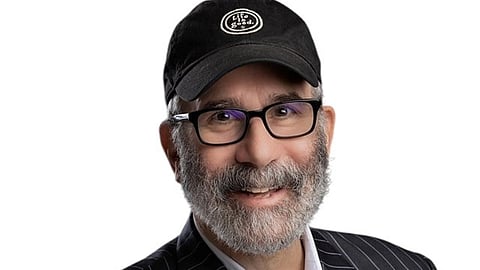

The first thing that strikes you about Gil Bashe is that he does not speak about healthcare as a distant policy expert. He speaks as a medic, a father, a business leader and, above all, as someone who has lived inside the system he critiques. In Hyderabad for BioAsia, the managing partner and chair of global health and purpose at FINN Partners, reflects on a career that has spanned four decades, and a book on Healing the Sick Care System: Why People Matter that has touched readers around the world.
“I chose to write a book in story form because people enjoy understanding the complexities of the health system not from a structural standpoint but from a human standpoint, and the system is often so frustrating for people,” he begins.

His motivation, however, runs deeper than professional experience. After years as a provider, policy advocate, entrepreneur and leader associated with organisations such as the American Heart Association and the American Diabetes Association, he found himself confronting the system as a parent. “My years involved in health and what I had seen, and I am also the parent of a child who has a rare disease. So there is a story within the story reflected in the book. I am not only seeing it as a person who has to interface with the health care system or deal with executives in the industry, but I am also seeing it as a parent, watching the behaviour of doctors, health professionals, and insurance companies,” he shares. That personal journey shaped the heart of the book. “It is not just that I am dealing with this intellectually, personally, and I write about that with my daughter’s permission. I write about these encounters with a system that has moved far away from why it was created. The system exists for itself today, even though it was created to address the needs of people, and since it has moved so far from its original intent, I felt it was time to write about it and get it to recalibrate,” he adds.
Drawing inspirations from his early years as a senior combat medic in the military, he explains how those experiences grounded him. “I served six years as the senior combat medic in a special unit, and in moments of medical trauma, I noticed how primal people’s questions were. Because of that, I have always stayed in that personal zone while dealing with the business mission,” he notes, adding that being mission centred has guided every company he has helped build.
Technology, he believes, has complicated matters further. Speaking about AI, he cautions, “One of the things I write about is that we’re developing technologies not with the user of the technology or the beneficiaries of the technology in mind, but we’re inventing a technology for the sake of technology, and I try to bring it down to a very human level.” While patients increasingly turn to large language models for answers, he warns that much of the information is unvetted. “On AI and health, we assume that when we ask ChatGPT, OpenAI, Copilot or other systems a question, we get an answer, but it is curated information, not analysed information, and data show 71% of health information is incorrect because it is human-fed information,” he shares.
As he looks around Hyderabad’s growing health innovation landscape, he speaks with admiration. “I’m thrilled to be here in this city for BioAsia, which is truly bio global and not just BioAsia. I’m moderating a key panel with members from India, Ireland and the United States. It’s appropriate this is in India, as it produces 30% of the world’s vaccines and is a global health power. With growing innovation hubs in health, cyber security and fintech, health is becoming one of the city’s largest employers, so it’s a great honour and experience for me,” he concludes.