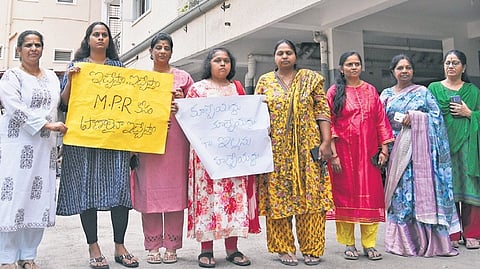

HYDERABAD: Residents of Madhu Park Ridge apartments have objected to the state government’s proposal to acquire structures within a newly defined 50-metre buffer zone as part of the Musi Riverfront Development Project, saying their homes were built with valid approvals and warning that the move could displace more than 2,000 people.
A government notification states that all structures within 50 metres of the riverbanks will be acquired, with compensation to be determined through surveys and prevailing market rates. Residents argue that the buffer zone was revised in 2012 and that their buildings were approved and registered after that change.
“If the structure became illegal after the buffer zone revision in 2012, how was registration allowed?” asked Sahil, who bought a flat in Madhu Park Ridge apartments in 2015. “Buying and selling continued with full registration, not notary arrangements. On one side, the government says it is illegal; on the other, it registers the property.”
Residents said no department had ever informed them that their buildings fell within the buffer zone. “Not once in 14 years did officials from irrigation, electricity, water, or revenue departments tell us this was a buffer zone,” Sahil said. “We received water and power like any other apartment. Why raise this issue only now?”
They questioned the timing of the declaration, which followed the riverfront project notification. “From a public perspective, it appears like pressure tactics—either surrender your property or it will be declared illegal and demolished,” Sahil said.
While opposing displacement, residents said they were not against development. “We are not rejecting the project, but it should not come at the cost of our homes,” Sahil said. “There is over 10 acres of government land behind this complex. Why affect 450 families when land is already available?”
The complex has more than 450 flats and about 2,500 residents. Srinivas, president of the residents’ association, said relocation would disrupt settled lives. “Many of us have lived here for 10–15 years. Our children grew up here, elders live here, and schools and hospitals are nearby. Displacement will disrupt everything,” he said.
Residents also raised concerns about the lack of consultation and transparency. They said they learnt about the notification through newspapers. “No official, corporator, MLA, or MP consulted us. A notice appeared in newspapers and the clock started ticking,” Sahil said.
Residents flagged the lack of transparency, noting that neither the DPR nor a preliminary report is publicly available. Residents are consulting lawyers and considering legal options, including approaching the high court.
Activists have expressed support, questioning whether displacement is necessary for river rejuvenation. “If the government is serious about cleaning the Musi, it should stop industrial pollution first. Demolishing homes does not address the issue,” said Prithavi Raj, an activist who attended a residents’ meeting. He added, “What is the cost of human relationships? Money cannot replace decades of community life.”
Residents have demanded that the acquisition process be halted and called on the government to release maps and project documents and hold consultations with affected families before proceeding.
