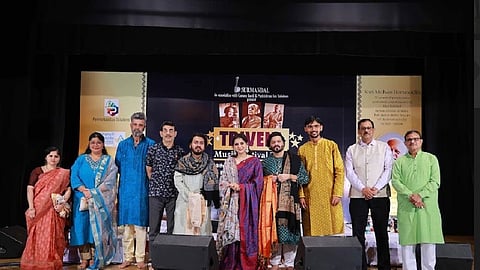

In January, as Hyderabad eases into a new cultural year, the air carries more than anticipation, it carries memory. For Surmandal, one of the city’s oldest classical music institutions, January is both a marker of time and a moment of renewal. This year, the organisation completed 57 years, while its flagship annual concert series, Triveni, enters its third season. For Siddharth Hemmadi, president of the Surmandal Foundation, the milestone is deeply personal, shaped by legacy, responsibility, and a growing passion for the arts. Triveni was envisioned by his late father, Mohan Hemmadi, who passed away in 2023, as a tribute to legends Pandit Ravi Shankar, Pandit Bhimsen Joshi, and MS Subbulakshmi, honouring the lineage and reverence central to Indian classical music.
Siddharth warmly recalls, “Triveni was something my father conceptualised before he passed away. Sadly, he couldn’t see the first season. Season one was dedicated to the memory of my parents, who both passed away that year. It was also my first real experience stepping into my father’s shoes and trying to understand what it takes to run an organisation like Surmandal.”
That first season, held amid grief and transition, became a profound learning curve. It also reaffirmed Surmandal’s long-standing commitment to inclusivity and nurturing emerging voices. Among the many performances, one moment has stayed with Siddharth. “We had a young boy, Aditya Jonnalagadda — an autistic child. He cannot communicate a single word in a normal conversation. But when he was put on stage and the mic was in front of him, he sang Carnatic music non-stop for an hour. That incident really touched my heart,” he expresses.
Season two followed in January 2024, featuring a jugalbandi by sitar maestro Ustad Shahid Parvez Khan and flautist Shashank Subramaniam at Ravindra Bharathi — a performance that drew seasoned rasikas and younger listeners alike.
The third season took a more focused curatorial turn. This year, the festival featured a single, full-length performance by one of India’s most celebrated vocalists — Kaushiki Chakraborty. “Over the years, we received feedback that having too many artists in one evening doesn’t always give listeners the satisfaction of hearing an artiste at full length. So this year, we consciously curated one artist,” he explains.
Surmandal’s origins, just like its music, were intimate and organic. When Mohan Hemmadi moved to Hyderabad in 1963, he found a circle of friends equally passionate about music. Informal baithaks in living rooms gradually evolved into something more structured. The turning point came in 1969, when Ustad Bade Ghulam Ali Khan visited Hyderabad. He recounts, “When my father and his friends met him and spoke about what they were doing, he was deeply impressed. It was Ustad Bade Ghulam Ali Khan sahib who blessed the organisation and gave it the name ‘Surmandal’.”
Surmandal’s influence on Hyderabad’s cultural identity extends beyond concert halls. “Nowhere else in the country have roads been named after artists the way they have been here. With the support of the Andhra Pradesh government earlier and now the Telangana government, roads have been named after Ustad Bade Ghulam Ali Khan sahib, Ustad Bismillah Khan sahib and others,” he points out.
Looking ahead, the foundation continues to experiment while remaining rooted in tradition. In February, Surmandal will curate a unique presentation for a global palliative care conference in Hyderabad — bringing together seven to eight artists playing rare, age-old instruments that are largely unfamiliar to contemporary audiences. “These are instruments even I hadn’t heard of before. But we’re putting together a kind of symphony with vocalists and instrumentalists. It’s part of our effort to engage younger audiences and explore new formats while staying true to classical music,” he concludes.
