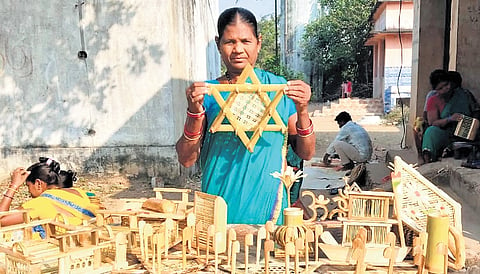

ADILABAD: In a world choked by plastic waste, a quiet transformation is taking shape in the forests of Telangana — one bamboo strand at a time. Inside a small tribal hamlet in Mancherial district, women who once depended on low-paying farm labour are now crafting elegant bamboo furniture and utility products, stitching together livelihoods that are both sustainable and empowering.
The initiative is being driven by the Entrepreneurship Development Institute of India in collaboration with the Hyderabad Tiger Conservation Society. Together, they are conducting a series of skill development workshops for tribal women living in and around the Kawal Tiger Reserve, part of the erstwhile Adilabad district.
The programme aims to create sustainable livelihood options while promoting women entrepreneurship among marginalised tribal communities. So far, 280 women across several villages have been trained in a range of income-generating skills.
One such intensive workshop was launched on December 14 at Nayakapugudem tribal hamlet in Indhanpally village of Jannaram mandal. Approximately 45 tribal women are currently learning the art of making bamboo furniture and products, working with resilient Assam bamboo under expert guidance.
From sofa sets and chairs to mobile stands, pen holders, bangle stands, office trays, flower vases, exam pads, foldable relaxing chairs, coffee trays and decorative items, the women are mastering products that blend utility with aesthetics. Bamboo, being ecofriendly and biodegradable, is increasingly seen as a strong alternative to plastic in a globalised yet polluted world.
Promoting bamboo-based products not only reduces plastic use but also opens up steady income opportunities for forest-dependent communities. EDII and HyTiCoS are now working closely with the trainees to strengthen skills and connect them to viable markets.
Trainees Raya Anasuya, Pembi Renuka, Raya Yashoda and Mudithe Sathya said agriculture and daily wage work brought them meagre returns despite hard labour. “With bamboo products, the income is better,” they said, adding that items made from Assam bamboo are being sold to visitors for `2,000 to `3,000.
Srinivas, a resident of Nayakapugudem who also underwent training, said learning to make bamboo sofa sets was both interesting and rewarding. “Here, we can earn about `600 a day, compared to `400 elsewhere. If we get a good market, it will secure a bright future for tribals,” he said.
Devender Bukya, project officer at EDII, told TNIE that the core objective of the organisation is to empower women by helping them become financially independent. “Many rural women work in unorganised sectors that demand intense labour but offer very low income. We aim to bridge this gap through skill training, entrepreneurship development and market linkages,” he said.
Apart from bamboo training, EDII has conducted workshops on leaf plate making at Lingapur village, detergent powder manufacturing at Beernandi, and fish pickles and other value-added fish products at Peddur village in Kadem mandal. Each programme focuses on improving practical skills, product quality and confidence, enabling women to take the first steps towards self-employment.
