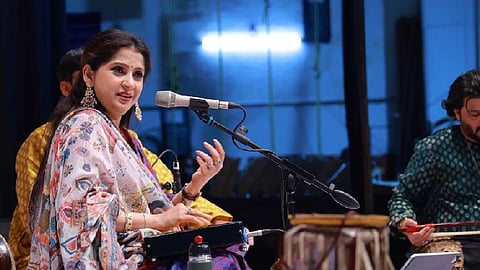

Some cities listen, and some remember. Hyderabad does both. Triveni season 3, by the Surmandal Foundation at Ravindra Bharati, featured Pt Kaushiki Chakraborty. She was the only performer during this event, encompassing an uninterrupted musical journey for the entire evening. For Kaushiki, Hyderabad represents so much more than just another concert to attend; it represents a part of her own and musical tradition.
“My association with Surmandal goes back a very long way. It started with my father Pt Ajoy Chakrabarty and Mohan Hemadi ji, the founder of the organisation, collaborating together. Mohan Hemadi ji and his family have always been extremely affectionate and supportive,” she recalls. Her earliest visits to Hyderabad were alongside her father, when she first began travelling and performing: “When people didn’t really know me, they trusted me. They kept inviting me back, and that trust is extremely valuable to me.”
Over the years, she has watched both herself and the city’s audience evolve together. “I’ve seen the Hyderabad audience grow with me,” she reflects, noting the presence of familiar faces across generations, alongside a growing influx of younger listeners. She further adds, “There’s fresh energy and enthusiasm now, and witnessing that journey has been very rewarding, humbling, and inspiring.” Every return feels like coming back to a place filled with memory and continuity.
Her bond with Hyderabad is also spiritual. The city is home to the mazar of Ustad Bade Ghulam Ali Khan, a place she visits whenever time allows. “That is the biggest pilgrimage for me here, and the most peaceful place,” she reflects. Beyond this deeply personal connection, she acknowledges Hyderabad’s distinctive position as a city with a long tradition of Hindustani classical listening. She states, “Even though it has a southern cultural temperament, Hyderabad has always been a city where Hindustani classical musicians found a discerning audience. Classical music here is part of the culture, passed down through generations.”
This year’s Triveni concert stood out for its single-artiste format, allowing the music to unfold organically over an entire evening. While such concerts are not uncommon in her career, Kaushiki emphasises the responsibility they demand. “You have to be very mindful of the pace of the evening and the audience’s energy,” she explains.
Drawing from years of experience, she curated a performance that moved fluidly through different shades of classical expression. She notes, “There must be variety — khayal, tarana, thumri, maybe a dadra or a bhajan — so the evening doesn’t become monochromatic.”
Reflecting on her artistic evolution, Kaushiki believes change is essential for creative survival. “As you grow in life, your musical expression also changes,” she expresses.
While technique remains integral, the emotional layers deepen with experience. She notes, “What we do in music can be learned, but why we do music — that sense of purpose — keeps evolving. When that changes, your relationship with music changes.”
Despite her growing popularity among younger audiences, she insists she makes no conscious effort to alter her music. “I don’t change anything. It is as traditional and authentic as possible,” she enunciates.
What resonates, she believes, is her natural way of connecting: “I’m a friendly person. I see music as my best friend, and I perform the way I would speak to a friend. That automatically makes it more accessible.”
For her, the concert hall is a shared happy space. She gushes, “I like it when the audience responds, when they are enthusiastic and involved. Music is where I am my happiest, and that happiness translates into my expression.” This openness, she says, is not curated, it is simply who she is.
Looking back, she finds it difficult to pinpoint specific transformative moments. “Transformation happens quietly, when you are most open and vulnerable,” she reflects. Music, for her, has always been the path to self-discovery. Yet she is quick to point out that music extends far beyond performance. “Music is not only when I sing or perform. It is also in how I think, how I live, how I feel compassion. Sometimes music is heard, sometimes it is felt. A soothing feeling in the heart — that too is music,” she concludes.
