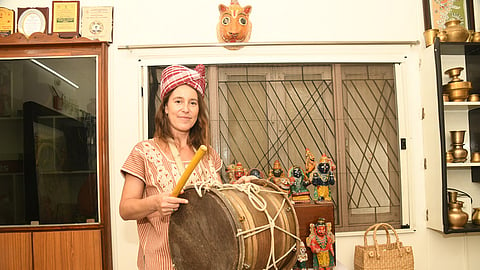

It is rare to find people today deeply invested in cotton cultivation, let alone in preserving its forgotten varieties. Few of us realise that cotton grows in many natural shades across the world, and cultivating them has become an increasing challenge. Maud Lereyer has dedicated her research to naturally coloured cotton, was recently in Hyderabad to document the story of this remarkable fibre. She is working closely with artist Ramesh Ramanadham, widely known for his contribution to the handloom sector and the only person in India currently focused on the cultivation of naturally coloured desi cotton. CE speaks to Maud about her journey, her research, and the book she is writing on the forgotten colours of cotton.
Excerpts
Tell us about your journey into naturally coloured cotton.
When I was 22, I moved to Mexico from France. I was supposed to stay for nine months, but I ended up staying for nine years. I fell in love with the country and its beautiful craft traditions. Back then, I wasn’t working in crafts, I was a student and doing my first job. Later, when I moved to New York, I started missing the connection with handmade processes and with the people who create beautiful things. I realised how much I loved the act of making. I wanted to start my own business and work with the artisans I had met in Mexico. That’s when I began travelling extensively to find unique handmade pieces. Very early on, I discovered an extraordinary textile in Guatemala made from brown cotton and indigo. Guatemala is known for its colourful textiles, so this subtle, earthy fabric stood out. When I asked about it, I was told that only one village still grows and processes this cotton. I went there the very next day. It was love at first sight. I had never seen or felt cotton like this before. I became fascinated by its story and wanted to know more. But when I searched for books or texts about brown cotton, I couldn’t find anything in any language. That’s when I realised there was a story waiting to be told. I started my company, Behind The Hill, because I travel far to find people who still grow and process this cotton. I work with hand-spun and handwoven cotton to create home textiles like pillows and blankets with artisans in Mexico and Guatemala. Another part of my project is to connect fashion brands from Europe and the US with these artisans. Coloured cotton is so beautiful that it doesn’t need dye. If people stop using chemical dyes, it would make a huge environmental difference. My goal is to include coloured cotton in mainstream fashion collection

Can you take us through your work in India?
I started my business in 2016. With India, my first collection came in 2021. It was made using brown cotton and natural dyes, and I created scarves which I sold until 2023 through my shop in New York and online. After that, I decided to focus more on research and storytelling. That is why I am now travelling around the world. Ramesh is my only contact for understanding cotton cultivation in India. I visited Gujarat, where I learned about kala cotton, which has a natural black tint. I would love to include that in my work. I also visited Khamir, an organisation that works with white cotton and natural dyes. Their philosophy aligns closely with mine, and I would love to develop a fashion collection using their fabrics. I would also love to work with Ramesh on extremely fine textiles and connect them with fashion brands.
Are you working with any fashion brands?
Currently, I am collaborating with two collections in France, and two in the US. I would love to collaborate with Indian brands, but I want to understand the Indian market better before taking that step.
Could you share a glimpse of your book?
The book is about the colour of cotton. Most people believe cotton only grows white. They also associate cotton with environmental damage, excessive water usage, and the painful history of slavery in the US. My aim is to tell the story of cotton’s ancestors, the naturally coloured cotton that existed long before industrial processing. Wherever I go — India, Guatemala, Mexico — I meet people who still protect these traditions and want to share their stories. In Central America, many farmers hid their seeds in their pockets because they were asked to stop cultivating brown cotton. They grew it secretly between papaya and coffee trees. The Spanish colonisers wanted only white cotton and tried to erase brown cotton entirely. Yet these communities preserved the seeds for generations, weaving their village stories into every fabric. This cotton could have disappeared 400 years ago. The final chapter of my book focuses on the revival of these forgotten cottons.
Future plans?
I want to find more communities working with coloured cotton. I know there are groups in Thailand — where cotton grows in blue, black, and many other shades hidden in the Amazon and Peru. I want to explore China as well, to understand whether their coloured cotton is organic. My goal is to build a global network of cotton growers. I want to continue designing home textiles and connect fashion brands with cotton growers, mills, and weavers. This is how awareness grows — when people can walk into a store and buy a beautifully designed shirt made from naturally brown cotton that doesn’t need dye. I want to be the connector between growers and brands, so that someday people will wear a beautiful garment and know it carries a story, a legacy, and a future for sustainable fashion.