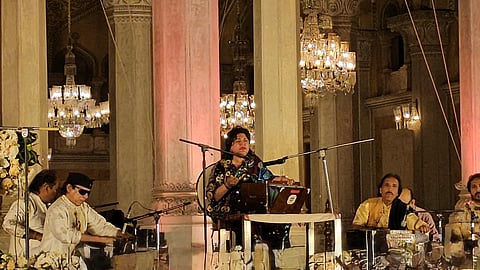

Chowmahalla Palace continued to be an active palace long after the sunset over the Charminar skyline. With bright warm lights illuminating the palace, it created an air of excitement. Once echoing with royal processions, now carried the softer rhythm of whispered conversations. Chandeliers displayed their radiant glow off marble floors while arches appeared to be inching towards the performances, as if listening to the soothing sounds. The evening brought a special night at the palace as they did not just host music simply; they incorporated music into their culture, and breathed life into sufi and ghazal music.
Curated by the Telangana Sangeeta Nataka Akademi, the evening marked the presence of governor of Telangana, Jishnu Dev Varma, as the chief guest, alongside chief minister A Revanth Reddy, deputy chief minister Mallu Bhatti Vikramarka, and minister for irrigation, food and civil supplies N Uttam Kumar Reddy, member of parliament and advocate for gender equity Renuka Chowdhury, mayor of the Greater Hyderabad Municipal Corporation (GHMC) Gadwal Vijayalakshmi, senior advocate and member of Rajya Sabha Abhishek Singhvi, and Minister for Minority Welfare & Public Enterprises and a former cricketer Mohammad Azharuddin, lent the evening its formal gravitas.
‘Tumhare shehar ka mausam bada suhana lagta hai, Main ek shaam chura loon agar bura na lage, ijazat hai,’ began the host as the event began. Passing over the mic, Prof Alekhya Punjala, chairperson of the Telangana Sangeeta Nataka Akademi, spoke about the state’s approach to nurturing art and culture. She said, “Art and culture are an inseparable part of Telangana’s identity. More than any other state, we have our own varied art forms. They are not limited to stages and auditoriums, but live in our villages and everyday life. Encouraging artists and preserving our varied art forms is essential for the state’s development.”
Speaking about Hyderabad’s cultural openness, she added, “Hyderabad has several mazhab and com, and this is the city where all the festivals are celebrated together. With my 50 years of experience I can say that Hyderabad is a city where people enjoy Bharatanatyam and Kuchipudi with the same warmth as sufi and ghazal. This acceptance of diverse traditions is what makes the city special.”
Recalling a personal memory, she referred to a conversation with legendary tabla maestro Ustad Zakir Hussain, who once remarked that performing in Hyderabad brought him renewed creative energy. “He told me that the city’s aura always led to a whole different excitement, leading to a better performance in its own way,” she recalled, adding that encouraging every form of art comes naturally to Hyderabadis.
The highlight of the evening was the performance by Anita Singhvi, which brought a beautiful combination of words, devotion, and music. Her programme featured pieces by Qateel Shifai and Jigar Moradabadi. She sang each of them at a slow, deliberate pace so that the audience could appreciate the poetry first. After she finished singing Hazrat Amir Khusrau’s Man Kunto Maula, a quiet silence filled the room after her performance; her rendition was very powerful. We also heard Mohabbat tere hai anjaam which followed the same theme of love, surrender, and introspection about a person’s spiritual life.
Reflecting on the experience, Anita Singhvi said, “Performing at Chowmahalla Palace feels special. It is a space that carries history and the presence of great musicians who have performed here before, including Ustad Zakir Hussain. When you sing at a venue like this, you become very conscious of the legacy you are stepping into.” She added that Hyderabad’s audiences bring a rare attentiveness to Sufi music, allowing artistes to perform without rush.
As the evening drew to a close, applause followed naturally, without spectacle. The palace slowly emptied, leaving behind a sense of quiet fulfilment — a reminder of how music continues to bridge history, faith, and lived experience in the city.
