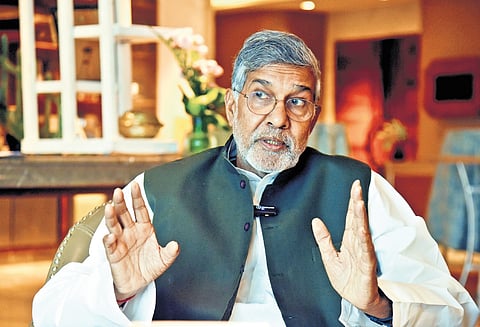

We often speak of compassion in a soft voice, linking it to charity and consolation. But what if we have had it wrong for centuries? Nobel Laureate Kailash Satyarthi, whose compassion has driven him to free thousands from slavery, argues that it is not a gentle emotion but a disruptive, courageous and transformative force. In an interview with TNIE’s Reshmi Chakravorty, he explains why redefining ‘karuna’ is not merely philosophical, but an urgent necessity for our divided age.
Could you tell us more about karuna and what inspired you to write it?
This book presents a completely new perspective on compassion (karuna). Traditionally, it is seen as a soft emotion — empathy, kindness, sympathy, mercy or benevolence. In Karuna, I challenge this centuries-old understanding. Based on 46 years of my life’s work in social transformation — some efforts successful, others not — I realised compassion is not soft; it is a force. I was never driven by political ideology, religious ritual or the promise of reward in heaven. What truly motivated me was compassion. It is born when we feel another’s suffering as our own, and it inevitably pushes us towards mindful action.
You describe compassion as a force. Could you explain that further?
Compassion is dynamic, disruptive and transformative. Human values alone cannot solve deep-rooted socio-cultural and structural problems such as gender discrimination, racial inequality or communal conflict. Preaching is not enough. Compassion becomes mindful problem-solving. When you are truly aware of yourself and others, you cannot remain silent — you are compelled to act. That is how a culture of problem-solving is born.
Why did you feel this was the right time to write the book?
Karuna is needed today more than ever. We live in the wealthiest, fastest and most connected time in history. We have laws, constitutions, UN conventions and countless programmes. Yet humanity has never been so divided and fragile. Often, our solutions create new problems because something essential is missing — compassion. There is a widening gap between problem-solvers and problem-sufferers, a moral deficit in responsibility, accountability and conscience.
Were there challenges while writing the book?
The book is rooted in real-life experiences — my own, those of children rescued from slavery and trafficking, their families and fellow activists. Three of my colleagues lost their lives in this struggle. I examined the psychological, emotional and spiritual strength that allowed people to continue despite immense danger. Across religions, revolutions and transformative movements, I found one common source — not passive empathy, but courageous, action-oriented compassion.
How do you define compassion in practical terms?
Compassion completes a full circle of awareness, connectedness, feeling and action. Loneliness has become a global epidemic — one in six people suffer from it, according to UN and WHO reports. This leads to depression, anxiety and insecurity. The way forward is to rebuild genuine connectedness — with ourselves and with others. Compassion must result in justice, equality, peace and sustainability. Only then does it become transformative.
Can compassion be taught, or are we born with it?
We are all born with compassion. Unfortunately, education systems and social structures often layer over it. Our task is not to create compassion, but to ignite it through experiential learning, exposure, volunteering, service projects and audiovisual training. We have already seen encouraging results.
You introduced the idea of a Compassion Quotient (CQ). Why is it important?
People know IQ and EQ, but both are largely individualistic. IQ often leads to comparison and discrimination, while EQ is frequently used to enhance productivity or profits. Compassion already exists within us. CQ measures its strength at a given moment and helps deepen it. In the near future, CQ will shape relationships, partnerships and even employment. It can be a true game-changer.

Where does Hyderabad stand in terms of CQ?
I am working on integrating Compassionate Intelligence with Artificial Intelligence. AI is rapidly becoming a self-driven force, possibly beyond human control. Hyderabad, as a fast-growing technology hub, has a vital role to play. Compassion must be embedded from the beginning — in data, algorithms and training. Rules alone are not enough.
After witnessing so much suffering, how do you protect your mental health?
Empathy can be dangerous; it can lead to fatigue. Absorbing suffering without action overwhelms you. Compassion is different. It generates courage, innovation, hope and action. It gives you the strength to say, ‘I will end this suffering’.
A moment when compassion changed everything?
A bonded labourer, Wasal Khan, once came to me. His teenage daughter was about to be sold to a brothel. I asked myself: if she were my daughter, would I only write about it, or act? That question led to a rescue mission and a legal battle that freed 36 bonded labourers. It marked the beginning of a global movement for children’s freedom.
What gives you hope today?
The youth. Their energy and courage give me hope. Across communities worldwide, compassion as problem-solving is finding resonance. People are searching for simple, effective solutions — and they already exist within us.