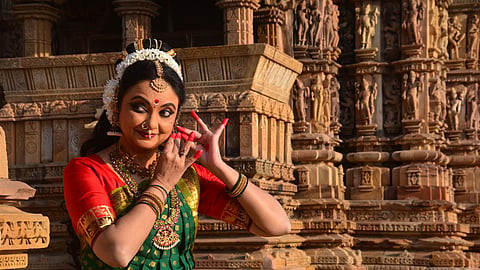

For over five decades, eminent Kuchipudi dancer, choreographer and teacher Deepika Reddy has devoted her life to the art form, transforming Kuchipudi into a vibrant cultural force in India and across the world. Over the years, she has mastered and presented its narrative richness, rhythmic precision and expressive depth — ranging from mythological classics to innovative productions with contemporary resonance.
Recently, she was conferred with the Padma Shri, in recognition of her profound contribution to classical dance. The honour stands not only as a celebration of individual excellence but also as an acknowledgment of a lifetime dedicated to art, tradition and creative integrity. The danseuse speaks to CE about her decades-long journey, the centrality of dance in her life, and the resilience that helped her emerge stronger through years of struggle.
Excerpts
With all the wishes pouring in from everywhere for the Padma Shri, how does it feel?
It’s very overwhelming and deeply humbling. When I first received the call, my immediate response was gratitude — to God and to the Government of India for bestowing this honour. Receiving a this prestige award is a dream for anyone, in any field. Anything connected to the country fills you with immense pride and joy. I turned 60 this year, and I truly believe all of this is God’s gift and my guru’s blessings.
You’ve been practising dance for over five decades now. How do you reflect on this long journey?
I started very young, and I simply fell in love with dance. I always enjoyed going to class — practising, interacting and learning. Even when my friends wanted to party or go to the movies, I never missed my dance classes. That was my joy. I never felt I was missing out on anything, even as a child. Even now, people joke that I’ll make a last-minute excuse to skip something — and I agree! But if there’s a performance or anything important related to dance, that has always been my priority.

Over such a long and dedicated career, what challenges have you faced?
There have been many challenges, especially health-related ones. Once you commit to a programme, you must honour it. I’ve danced with a 104-degree fever, with low blood pressure, and even with a fractured toe. Commitment means overcoming these hurdles. There were also a few years when I had to step away from dance due to health reasons, but by God’s grace, I was able to return. Apart from health, I never really felt anything else was an obstacle.
You’ve often spoken about the support of your family. How important has that been?
Extremely important. I’ve been blessed with unwavering support — from my parents, husband, children, everyone. I’m truly fortunate.
You also teach. How has that journey been?
Teaching is the most fulfilling part of my life. In today’s world of increasing westernisation, being able to share our traditional knowledge with youngsters gives me immense joy. I feel proud seeing my students perform so beautifully — they choreograph, teach, and carry the art forward. My students are spread across the globe, and watching them do so well fills me with happiness and pride.
Hyderabad has long been known for its Kuchipudi legacy. How do you see the future of the art form?
The future is very bright. There is remarkable talent among youngsters today. They are deeply committed and hardworking. Many of them realise that learning an art also helps them academically — it sharpens the mind, improves memory and builds discipline. They are doing excellent work.
Do you believe dance helps beyond the stage, in everyday life?
Absolutely. First and foremost, health is wealth. As performers, we remain physically fit because of constant practice. Dance also brings peace of mind — it demands focus on movement, expression and storytelling. With mythological themes, it even becomes a form of worship. Memory power improves, teamwork develops through group productions, and students learn to adapt to different people and situations — skills that help them greatly in academics and at the workplace.
Does technology or social media play a role in your work today?
Social media is widely used by youngsters, and it does have its benefits. We come across exceptional talent through videos and posts. For research, we also use various platforms and mediums to study themes and ideas for our productions. It has become a useful tool when used thoughtfully.
Are you working on any new productions or performances?
Creativity gives me great joy. Along with mythological themes, I also work extensively on social themes to convey meaningful messages to society. We are always thinking of the next project — once one is completed, the next journey begins. Over the past few years, we’ve been performing at all the major festivals across the country — Khajuraho, Konark, the Mahakumbh, Ayodhya, G20 events, and many others. I’ve also had the honour of performing before Prime Minister Narendra Modi ji. It’s a continuous process, and my students are working very hard alongside me.