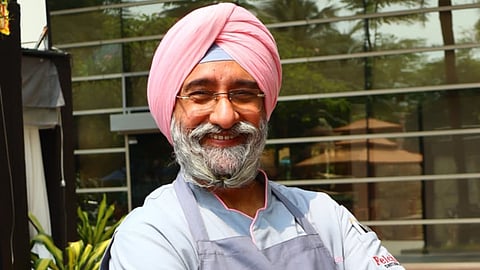

The story of Kashmir is often told through its mountains, its poetry and its seasons. But for Chef Parvinder Singh Bali, it begins in the kitchen — in the quiet discipline of a waza at work, in the perfume of saffron steeping slowly, in the steady rhythm of ladles stirring yogurt gravies over a patient flame. Founder of the School for European Pastry and Culinary Arts, Chef Parvinder has spent decades mastering global techniques, yet it is the cuisine of his homeland that remains closest to his heart.
At Zaika-e-Kashmir, his thoughtfully curated pop-up at the Novotel Hyderabad Convention Centre, he brought not just recipes but remembrance. Hosted across Permit to Grill and Food Exchange, the dining experience unfolded like a culinary narrative — one that honoured tradition over trend, depth over drama.

For many, Kashmiri cuisine begins and ends with wazwan — the elaborate ceremonial feast famed for its lavish spread of meat dishes. But as Chef Parvinder explains, “People often associate Kashmiri food only with wazwan. But it is just one part of a much wider food tradition.” Traditionally served at Muslim weddings, wazwan — literally a feast prepared by a master chef or waza — is not everyday fare, even in Kashmir. The region’s food culture is shaped by three distinct culinary streams: Muslim wazwan cuisine, Kashmiri Pandit cuisine and the lesser-known Sikh cuisine of Kashmir.
Kashmiri Pandit cooking follows strict dietary principles, notably avoiding onion and garlic, yet producing remarkably robust flavours, particularly in lamb preparations. These practices evolved partly from necessity. During harsh winters, when fresh vegetables were unavailable for months, dried ingredients and carefully preserved spices sustained households. Sikh cuisine, meanwhile, borrows from both Pandit and Muslim traditions while incorporating Punjabi influences, resulting in richer gravies and layered textures.
For Chef Parvinder, these traditions are deeply personal. Childhood visits to his ancestral village near Baramulla, along the road to Gulmarg, were marked by week-long weddings, communal cooking and meals served in generous courses. Food, he learned early, was not merely sustenance but identity — an anchor to land and lineage. Despite mastering elaborate techniques and ceremonial feasts, his own tastes remain disarmingly simple: rice with ghee, dal and seasonal vegetables.
Philosophy of slow cooking
At the heart of Kashmiri cooking lies patience. Meat is cooked gently over low heat for hours, allowing fibres to tenderise and flavours to deepen naturally. There is also a philosophy of complete utilisation — every cut of lamb is assigned a specific purpose, ensuring nothing goes to waste.
Signature dishes such as Rogan Josh, Guchi Pulao and Tabak Maaz exemplify this precision. The Pandit-style Rogan Josh, prepared without onion, garlic or tomato, surprised diners with its vibrant red hue and deeply rounded flavour.
Tabak Maaz, a prized lamb rib delicacy, undergoes nearly six hours of preparation. The ribs are first poached slowly in milk and spices before being shallow-fried to achieve a delicate crispness. We also relished Nadru Ki Shammi, Doon Maaz, Kokur Dhaniwal Korma and Rajma Gogji served with Saufiyani Kesar Naan — all rounded off with the delicate Kong Firin, a semolina and milk pudding perfumed with saffron.
From saffron-infused kahwa to yogurt-based gravies and slow-cooked lamb delicacies, Kashmiri cuisine tells a story shaped by climate, community and centuries-old craft. Beyond the spectacle of wazwan lies a deeper narrative — one where every dish carries history, every technique reflects survival and adaptation, and every meal becomes an expression of Kashmir’s enduring cultural harmony.