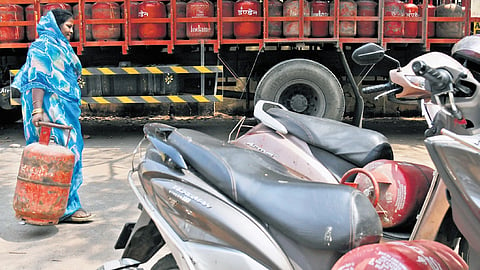

HYDERABAD: Restaurants across the state are facing the prospect of a commercial LPG shortage after an order by the Union government directing oil marketing companies to prioritise domestic consumers led to several distributors halting or restricting supplies to eateries.
The development has raised concerns across the restaurant industry, which depends heavily on LPG for daily operations. According to the National Restaurant Association of India (NRAI), the sector includes more than 5 lakh restaurants nationwide, generates an annual turnover of about Rs 5.7 lakh crore and provides direct employment to over 80 lakh people. Hyderabad alone has more than 75,000 restaurants.
Sandeep Balasubramanian, head of the Hyderabad chapter of NRAI, said the impact could be severe because most commercial kitchens are designed around LPG systems.
“About 95 to 96% of restaurants operate entirely on LPG. Commercial kitchens are designed around LPG-based systems, and switching to alternatives cannot happen overnight,” he said.
From Tuesday morning, restaurant owners across the city said vendors began informing them that deliveries would either stop or be restricted. “The moment distributors started informing restaurants that deliveries would be limited, the entire industry realised that a serious supply disruption was under way,” Sandeep said.
Because of the limited supply, restaurants may soon be forced to shorten operating hours or scale down menus if the situation continues, he added.
The concern is particularly acute for smaller operators such as messes, caterers and family-run eateries that rely on frequent cylinder refills.
S Venkat Reddy, president of the Telangana State Hotel Association, said most establishments maintain only short-term stocks.
“Not every restaurant has the capacity to store large numbers of cylinders. Most businesses typically have stocks that will last two to three days at most, depending on their scale of operations,” he said.
“The sudden stoppage of commercial LPG supply leaves restaurants with very little time to make alternative arrangements. If the government had given some notice or introduced a rationing system, restaurants could have adjusted menus and continued serving basic items,” Venkat Reddy added.
While cooking on induction stoves is technically possible, he said most kitchens are not equipped with the electrical infrastructure required for such a shift.
Some restaurant owners had anticipated the disruption. Naga Bharana, founder of a Hyderabad-based restaurant chain operating five outlets, said his team had arranged additional cylinders in advance.
“For the last four or five days we had been hearing about supply disruptions. So we arranged additional cylinders from our vendors,” Bharana said.
Because his restaurants maintain larger reserves, they currently have enough LPG to operate for about a week. “We normally keep around 70 to 80% extra cylinders as backup. That is what is helping us manage right now,” he said.
However, he warned that the buffer would offer only temporary relief. “After a week we don’t know what will happen. If supplies don’t resume, this could affect the restaurant industry just like the pandemic did.”
Some establishments are also exploring alternatives such as firewood cooking, though Bharana said these options have practical limitations. “Firewood cooking takes time to heat up and cannot easily replace LPG-based high-pressure cooking systems used in commercial kitchens.”
LPG distributors say the disruption reflects a broader national situation linked to supply constraints. Prateek, owner of Sri Chakra Gas, an LPG distributor in Hyderabad, said the shortage is affecting the entire country.
“This is not a Hyderabad-specific issue. It is a national crisis affecting the entire country,” he said.
India consumes roughly 31 million tonnes of LPG annually, with around 90% used for domestic consumption and about 10% used commercially by sectors such as restaurants, hotels and industries. Because of the shortage, authorities are prioritising household consumers.
“The government is doing the right thing by ensuring domestic households get priority. The country cannot afford a situation where people at home run out of cooking gas,” he said.
The National Restaurant Association of India has written to the Ministry of Petroleum and Natural Gas requesting continued supply of commercial LPG cylinders. The association warned that stopping supplies to restaurants could lead to closures and affect millions who rely on eateries for daily meals.
Some trim menu to save gas
Hyderabad: The disruption in commercial LPG supply is now affecting restaurants, hotels, street food vendors and paying guest (PG) accommodations across Hyderabad, forcing many to ration gas use and trim menus.
Several establishments said they attempted to book their usual number of cylinders but were assured delivery of only 30% of the order. Businesses that earlier ordered about 50 cylinders a month said they will now receive around 15, cutting supplies by nearly 70%.
Hotel operators said they are prioritising basic items and avoiding dishes that require longer cooking time or higher gas use. “Earlier we ordered 50 cylinders a month, but now even if we place the order we are told we will receive only 15.
We have to plan carefully how to use them. We are managing with fewer dishes and shorter cooking hours,” a hotel operator said. The shortage is affecting small hotels, roadside vendors and PG kitchens the most, as they depend on daily cooking and frequent refills and usually lack storage capacity for large numbers of cylinders.
Street vendors said uncertainty over cylinder deliveries is affecting daily business. “We prepare fresh food every day and rely on regular gas deliveries. If the cylinders do not arrive on time, we simply cannot open our stall,” said a tiffin vendor. “Even reducing the menu is difficult because most of our items require gas.”
