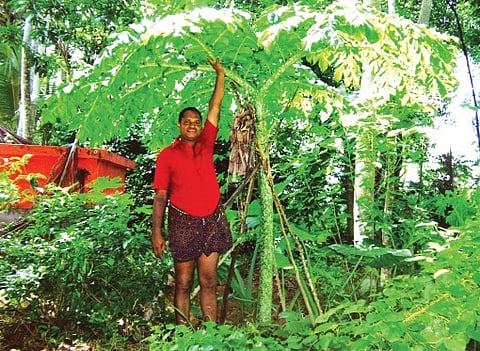

A farmer from Neyyattinkara, V S Syamkumar, is on a mission to grow the world’s biggest elephant foot yam, using just organic farming techniques. The height of the plant is currently 278 centimetres and the girth at the root is 68 centimetres.
It is only five months’ old and there are five more months to go. In the mean time, Syamkumar hopes that it gains more than 100 kilograms. He is trying for a Guinness Book of World Records entry. Earlier, he had been in the news for harvesting a 138 kg tapioca, which he had collected from the Kani tribe.

“We can ensure that a good crop is produced if the leave cover is healthy and green through out the entire nine months,” Syamkumar says. He has many a tip in his kitty which helps him to avoid chemical fertilizers. He prepares a nutritious mix for his giant yam and many unusual ingredients including jaggery, ghee, cow milk and tender coconut water go into making it.
“Instead of Urea, I used the urine of the cow at my farm. However, after it died, I use goat’s urine, which procure from the neighbourhood,” he says. He says that the loss of his cow has made life a little difficult. However, he champions the cause of farming, and would not mind helping those interested in learning his techniques. “My number is 8281842885,” he offers, like he were a farm helpline.
The elephant foot yam variety that he is cultivating is called ‘Gajendra’ and it is a popular variety from Andhra Pradesh, which CTCRI has been distributing. It does not itch much like other elephant foot yams and has high starch content. He uses beneficial micro-organisms isolated from the soil by the Agricultural Microbiology Division at Vellayani Agricultural College. Among these is Pseudomonas Fluorescens, a biocontrol agent which not only arrests fungal and bacterial infection, but triggers the growth of plants.
K S Meenakumari, Head, Agricultural Microbiology Division, says that PGPR Mix 1, which he uses, can help replace 25-50% of chemical fertilizers. This consortium of microorganisms helps absorb Nitrogen-Phosporus-Potassium. Syamkumar says he has managed to replace the other 50 % of chemicals with organic manure. The enterprising farmer has won many prizes and honours from ICAR-CTCRI. C S Ravindran, who recently retired from CTCRI as the head of Crop Production, says, “Farmers like Syamkumar help the institute as they contribute germplasms of rare species they collect.”