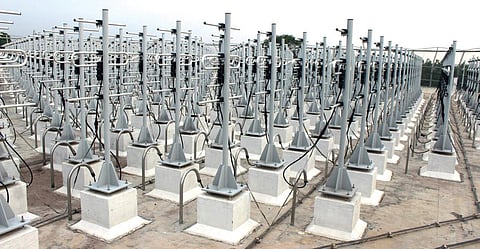

KOCHI: Kerala, which has been a trailblazer in very many fields, is now all set to make a new mark in the world of science and technology with the installation of the 205 Mhz Stratosphere-Troposphere (ST) wind profiler radar.
The ST radar, which will be mounted at the Advanced Centre for Atmospheric Radar Research (ACARR), Cochin University of Science and Technology (Cusat) to study the monsoon dynamics, is the first WPR in the world operating at 205 MHz with a bandwidth of 5 MHz.
Union Minister of Science and Technology Harsh Vardhan on Tuesday will dedicate the ACARR to the nation.
“In the near future, this radar can be used to accurately predict the onset and variability of the monsoon through a continuous monitoring of monsoon circulation. In addition, prediction of heavy rainfall events, occurrence and evolution of thunderstorms and turbulence studies can be accurately done using this radar. The radar can benefit aircraft operations by disseminating information on lower-level turbulence and horizontal wind gradient. The radar has been designed to operate round-the-clock for another 20-25 years and it is anticipated significant contributions can be made towards studies on climate change,” a Cusat release said.
The centre is being run by a dedicated team comprising co-principal investigators of the project - Mohan, Vasudevan and K R Santosh; engineers - Titu Samson, Rakesh V, Rejoy Rebello and Sunitha Nair and scientists- Ajil Kottayil and M G Manoj.
“The unique location of the radar at Kochi, a region nestled between the Arabian Sea and Western Ghats, is best suited for the study of monsoon dynamics than any other location in the country,” the release said.
The idea of a wind profiler was mooted as early as in 2006 by K Mohanakumar, incumbent ACARR director and principal investigator of ST radar project, when Science and Engineering Research Board, Department of Science and Technology called for proposals under the Intensification of Research in High Priority Area for setting up of radar wind profilers across India.
CUSAT emerged first in securing the ST radar project after outwitting many other prestigious institutions in India, including ISRO, IITs and Indian Institute of Geomagnetism. The `25 crore earmarked for the project is the Science and Technology Ministry’s biggest allocation for any project till date.
According to the release, the radar has been visualised, designed and developed indigenously under the ‘Make in India’ initiative thus putting the country on an even keel with the developed world.