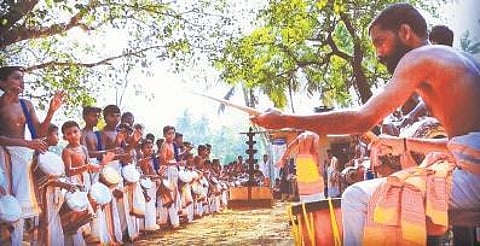

KOCHI: Kerala is known for its rich history of percussion arts and instruments. From temple-related ensembles like panchavadyam to tribal music, the state has a myriad of percussion-dominated genres and artists. But, this rich history has rarely been recorded, including details of artists and the origin of certain instruments. To remedy this, the Sopanam School of Panchavadyam in Malappuyram has taken up the task of creating a database of percussion artists going back as far as 400 years.
“We don’t know the history of our Melam arts. So, as a first step, we are creating a book on percussion artists since the 17th century — around the time of Shadkala Govinda Marar, the famous Sopana singer,” says Santhosh Alankode, the director of Sopanam School. The book will contain the evolution of each vadyam and details of the artists who practised Sopana Sangeetham and instruments like Thimila, Madhalam, Chenda, Idakka, etc. Since last year, they have collected information on around 6,000.
The ideation
Santhosh had plans to get into documentation since 2013. “There’s a line in one of Kunchan Nambiar’s verses describing an artist wearing the Madhalam on his waist. But if you look at the history of Panchavadyam, the first time someone performed Madhalam tying it around their waist was at Thrissur Pooram, sometime between 1920 and 1930. Before that, it was hung around the neck. But then, how did Nambiar, who lived in the 17th century, write about Madhalam around the waist?” he asks.
When Santhosh met R Ramachandran Nair, the then chief secretary of state, to know whether Panchavadyam can find a place in Unesco’s heritage list, he realised the need for historic records on it. That gave Santhosh a concrete reason to work on the scripts.
Their process
A team of four collects the information they receive over the phone and emails from the other percussion artists. As the vadyams are mainly carried on by family members, data collected from one artist gives an account of at least three generations of their predecessors. There are also brief accounts of few artists in books like Aithihyamala by Kottarathil Sankunn on old palm-leaf texts (thaliyola). With the help of historians, the school plans to collect as many references as possible.
HELP FROM EXPERTS
Eminent artists, historians and literary figures are supporting the school in completing this mammoth task. Mattannoor Sankarankutty Marar, thimila artist Kariyannur Narayanan Namboodiri, Poet Alankode Leelakrishnan, and filmmaker Anjali Menon are supporting the team.