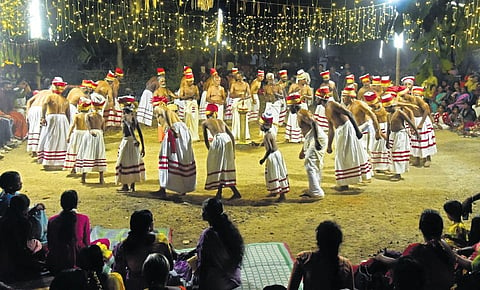

KOCHI: The beats of Chenda Melam and Elathalam slowly pierce our ears as we step down to the Kulavanmukku bus stop in Palakkad around 9.30pm. Despite the roar of passing vehicles, the melam from the Sree Kurumba Bhagavathy Temple, just 500 meters away from the main road, is clear as a bell.
At the temple, a lamp is erected on a round wooden frame on the ground and a tree is decorated with small yellow, blinking lights.
With people gathered around the traditional and modern lamps and flowers hanging around the premises, the village is immersed in celebrating the Kanyarkali Maholsavam, ritualist folk dances performed in the temples of Palakkad.

While most have found their seat on the ground, a few grab the chairs strewn around the ground to watch Vattakkali, the most attractive part of the Kannyarkali. Interestingly, though called Kanyarkali, the performers are all men. It’s the men from the carpentry community that performs Vattakali, a circular dance to the tune of a devotional folk song.
The Kaliyachan, or the main singer, recites the Vaythari, and the performers speed up as per their tune. Musical instruments like Chenda, Maddalam, Elathalam, and Chengila accompany the performance.
As soon as Vattakkali ends, the Porattu drama, an interfusion of dance, folk music, satire, and humorous dialogues, begins taking the viewers to a high note. The performance that kicked off at night goes on till dawn.
“This is a ritual that lasts for 14 days in temples. Just a few communities celebrate the Kanyarkali festival in the district, including the Nair community. Only the Ezhava community has not taking part in the festival, which is mostly celebrated in Kurumba Bhagavathy temples,” says N Sukumaran, 67, an elder.
Performed during March-April in temples as well as in places called the ‘Thara’, a venue for informal gatherings, Kanyarkali festivals include rituals such as Kummatti, Karivela, Chakkara Chambal, Andi Kali, and Valluvan Kali Malama.
The origin
In the earlier days, communities in Palakkad were associated with agriculture. “And during those days, cultivation was purely based on the timing of rain. People from different communities perform various ritualistic folk arts to pray to God. However, a few believe that Kanyarkali originated after the devotees started performing for the grace of Krishna, who is believed to have visited the place. The festival ends with praises of Krishna called Malama,” says N Muraleedharan, another local resident.