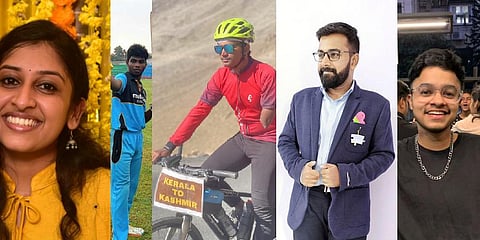

A life in service
Shainu Mohan
Twenty-four-year-old Sreelakshmi Sreekumar has devoted her life to the service of fellow beings. From organising blood donation campaigns to doing voluntary work for children from marginalised communities, the Thiruvananthapuram native is steadfast in her commitment to social work.
Having lost her father at the age of 13, Sreelakshmi had to fight against all odds to pursue her studies. “My mother is a Khadi weaver. After losing my father, life became a struggle for my family. I started giving tuitions to students when I was in Class 10. I wanted to be a journalist, but pursued BSC Physics,” she says.
Sreelakshmi adds she was always passionate about social work, and was a part of NCC during her school days. So it only seemed right to take up MSW after her graduation. She has spearheaded many campaigns to raise awareness on blood donation. “The daily demand for blood at various hospitals in Thiruvananthapuram is around 600 units.
We conduct blood donation camps and encourage youngsters to donate blood,” says Sreelakshmi, who is the chairperson and youth general convener of All Kerala Blood Donors’ Society. “We have been organising many innovative programmes to encourage blood donation involving school children.”
Sreelakshmi also works with the Kaval Plus project of the state government. “I give life skill coaching, and conduct counselling sessions for parents,” she says. “A majority of the work I do is on a voluntary basis, and I manage to do all this without letting it affect my studies.”
Last June, Sreelakshmi raised Rs 1 lakh to help children from poor backgrounds. “I used the funds for distributing study materials for children of migrant labourers and those from coastal areas,” says the civil service aspirant.
Sreelakshmi has bagged several awards for her relentless service, including the ‘Voluntary Blood Donor Award’ from Sree Chithra Tirunal Hospital, and ‘Change Maker Award 2020’ from the We Create Lives NGO.
Pedalling his way to Paris
ARYA UR
Hailing from a middle-class family in Malappuram, Fahis Farhan always dreamt of owning a cycle like his friends to go to school. But born as a congenital amputee, he knew he could not entertain such a dream.
However, the very dream became the driving force that made 19-year-old Fahis become one of the five cyclists in the Indian Paralympics cycling team, which will represent the country in the 2024 Paralympic Games to be held in Paris.
Fahis is a second-year BA history student at Malabar Christian College, Kozhikode. His passion fuelled his entry into the India Book of Records and Asia Book of Records for covering the maximum distance on a bicycle by an arm amputee.
“It was my attempt to test myself and show that anything is possible if we have a strong mind. I began my cycle ride from Thalappara on July 4, 2021, and reached Khardung La pass in Ladakh on August 19. I completed the journey in 47 days, covering 4,764 km. It was the best moment in my life; I felt like I had conquered Mt Everest,” says Fahis, who is now undergoing training for the Paralympics.
Fahis started cycling at the age of 12 with one of his cousins. To ride single-handed was a daunting challenge. “I don’t have my left hand below the limb by birth. I did not want to shut myself due to this disability, but looked for options through which I could excel,” he says.
“When my parents saw me excelling in cycling, they bought me bicycles. I always dreamt of becoming a sportsperson.” While studying in Class 11, he displayed his riding skills by attempting a 350km ride from Vengara to Ooty in 2019. Later, during the pandemic he, along with other cycle enthusiasts, embarked on a cycle expedition from Kasaragod to Thiruvananthapuram – a six-day ride covering 800km.
That tour made the youngster think big. Fahis decided to conquer one of his “dream destinations” – Kashmir. “It was a challenging ride as, after reaching Kashmir, my co-cyclist Jilshad and I chose to head to Khardung La as a daredevil act. For me, it was a task to prove myself and my mental strength. The oxygen level was low. The 12km-ride from Ladakh to Khardung La made me strong enough to face any challenge with confidence,” smiles Fahis. who dreams of winning a gold medal for India at the Paralympics.
Man on a vision
George Michael
College student Jibin Prakash is visually impaired. Yet, he has a clear vision. And has set his sights on a dream – to become an international cricketer. The 19-year-old Malappuram native is a professional blind cricketer, and helms the senior academy team of the Cricket Association for the Blind in Kerala (CABK).
Categorised as a B1 player (little to no sight), Jibin, who had suffered an optic nerve impairment at birth, is currently pursuing a degree in arts at Sree Kerala Varma College in Thrissur. Express came across him at a recent friendly organised by CABK in Aluva.
Jibin fell in love with cricket in his primary school days. Fortunately, CABK seniors spotted his talent and passion for the game. In 2018, he became one of the youngest players ever to get selected to the Kerala blind cricket team. In 2021, he got to participate in the national team’s camp in Bengaluru.
Though initially appearing a tad reserved, Jibin opens up as we start talking cricket. “The happiest moments of my life have been my achievements through the game,” he says. “Getting selected to the state team was a huge surprise, as I superseded several seniors of that time.”
Jibin says what makes him most happy, however, is learning that he inspires many kids and teens to take up cricket. “There is no limit for us,” he smiles. The national camp in Bengaluru gave him a “lot of exposure”, especially in terms of interacting with similar players from across India. His dream, Jibin says, is to become an international cricketer. “All thanks to CABK and its members,” he adds. “It is like family; they guided me through many difficult phases.”
Trans warrior
George Michael
College student Vihaan J Muralidharan’s life story is all about battling prejudice, and advocating the rights of the queer community. Assigned as female at birth, the 21-year-old Kochi native came out as queer in 2018. Two years later, he declared himself a transman.
Vihaan shared with the world every stage of his “transition journey” via social media. He clearly recalls the day he chose to reclaim his ‘real’ gender, and life. “On May 7, 2021, I received my first dose of testosterone,” he says. Today, Vihaan has emerged as a beacon of hope for the transgender community, as he has been documenting his journey ever since that D-day on his Insta page (@Veemanten).
Vihaan first came out on December 5, 2018. The backing he received from close friends and loved ones was a “pillar of support”, he says. “People should understand the need to educate themselves on the importance of gender identity,” he says. “Making the slightest effort would do; it is nothing compared with what queer people go through on a daily basis.”
A member of the Transformation Fellowship under Tata Institute of Social Sciences (TISS) and Collective Good Foundation for Transgenders, Vihaan is an active participant of various queer communities. He plays ‘editor’, too, writing and packaging articles advocating LGBTQ+ rights for local community publications. Vihaan has also been regularly voicing troubles a transperson faces while transitioning – from the frequent hormone injections to the legal documentation rigmarole.
“I have seen and been through a lot, including deteriorating mental health and multiple breakdowns,” he says. “But, finally, seeing the Gazette notification with my chosen gender and name made me truly the happiest man.” Vihaan, however, says his battle against unfair cis-privilege will continue. “It gives me great joy to see queer people, especially from the downtrodden strata, emerge and do well in life,” he adds. “A lot of silent sufferers reach out to me via social media, and I do whatever bit I can to help them reset their lives.”
Encouraging, empowering youth
Mahima Anna Jacob
Taking up social issues was never a part of the plan for Gautham Ravindran, the 26-year-old founder of Non-Government Organisation 360 Degree and CEO of Volunteer for India. Right from his childhood, he was rather a shutterbug.
His passion for photography took him places, and brought him in touch with other enthusiasts. And networking over social media led to the formation of his photography group, 360 Degree, in 2014.
Little did the then 12th-grade student based in Thiruvananthapuram know that the very group of five members would turn into an NGO spearheading change in society. Unlike a typical NGO, Gautham says, 360 Degree motivates the youth, especially the student community, to work for social issues.
“At 360, we believe that the idea of contributing to society has to come from a young age itself,” he adds. “The youth have the potential to make the world a better place. This is a platform that encourages and empowers them to work on the most relevant social issues.”
It all started with a photography exhibition organised by the group. “At one exhibition, we were able to sell frames worth Rs 60,000,” recalls Gautham, who is a law graduate. “We decided to give away the money for charity. That made us think: if five of us could do so much for a charity, then how much change can be brought if a larger group of likeminded people is brought together.”
Since its inception in 2016, the NGO has delivered some remarkable initiatives. For instance, the ‘Gift A Story Project’, which was launched after the 2018 Kerala floods, still continues. Currently, volunteers are now looking to set up home libraries for children across the state.
The ‘Last Straw Project’, in collaboration with World Wide Fund for Nature, organised awareness campaigns against plastic items. The ‘Run for Her’ marathon held in Thiruvananthapuram, Kozhikode, Bengaluru, and Amritsar, focused on highlighting the issues faced by women.
The collective also conducted Thiruvanthapuram’s first national-level Model UN conference, which was launched by Congress MP Shashi Tharoor. Notably, Gautham has also taken up the US Consulate’s ‘Volunteer for India’ project, which works on issues including mental health menstrual hygiene, child sexual abuse, and waste management.