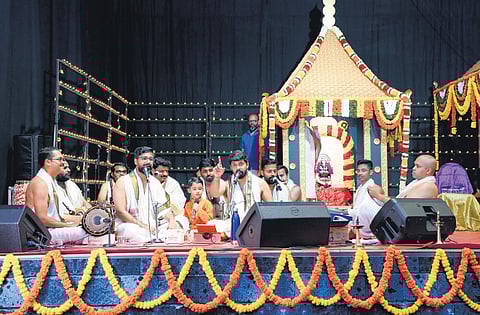

KOCHI: Across the country, January 22 (Monday), marked the consecration of the Ram temple in Ayodhya. But for art lovers in Thiruvananthapuram, it was another occasion to enjoy soulful songs laden with melody yet with a sweetness about the lyrics that convey passionate, personal emotions towards the divine.
Such songs constitute the art form of sampradaya bhajan, a centuries-old genre that fosters cultural camaraderie among people who follow the bhakti tradition or the spiritual path to devotion.
On Monday, singers of the art assembled in good numbers at Ayodhya Nagar, a tranquil space on the north side of the famous Sri Varaham temple in the capital. The serene hall, which also incorporates a Rama shrine and done up aesthetically with figurines of stalwarts of music and spirituality, hosted the ‘Bhajana Samagamam’, where 15 groups of musicians from across Thiruvananthapuram sang as per the sampradayam schedule.
The assembly was akin to the famed Thyagaraja festival, where singers come annually to commemorate the birth anniversary of the saint-musician Thyagaraja, says V Ramakrishnan, the secretary of Ayodhya Nagar trust.
Formed in 1964, the trust is one of the major forums where such sessions are held regularly.

Though such public forums for the art form emerged just about 50 years ago, sampradaya bhajan as a tradition has remained a staple in the streets of East Fort, Karamana, Valiyasala, and Sree Varaham in Thiruvananthapuram for more than 100 years.
“The Sahasaranama japamandali in SS Street Karamana was among the first to organise public forums for sampradaya bhajan,” says Girish Kumar, managing trustee of the Jnanambika Research Foundation for Vedic Living, which organised a recital by Vittal Bhakth Sangh and Trivandrum Ramesh Bhagavathar on January 22 at Sri Anjaneya Swami Temple in Karamana.
“We also held a veedhibhajanam where singers joined common people for a walk through the streets. Anyone could participate in the programme,” he says.
Veedhibhajan was also held at Puthen Street on January 22, says R Suresh, an office bearer of the Ramavarmapuram gramasamudayam. The locality also has a few groups that train regularly in the sampradaya system, he says.
With roots connecting to the Vedic era, the art form is largely based on the Samaveda Samhita, more meant to be sung as a musical score than read as a text. When sung as a package, they are termed namasankeerthanam. People trained in the art are considered senior among classical singers and are hence called bhagavathars.
“It sure borrows from Carnatic and other streams of music but is an art form with a proper framework or sampradayam and was compiled in the late 18th century by Maruthanalloor Sri Sadguru Swamigal based on the works of several stalwarts. Much like Carnatic, this too has its trinity: Bodhendraal, Sridhara Ayyaval, and Maruthanalloor,” says Trivandrum Shankar Bhagavathar, who helms the Sadhguru Gopalakrishna Nama Prachara Bhajana mandali.
Sampradaya songs mostly harp on a personal love for the divine, as was the hallmark of the bhakti era, and hence poets whose songs have been incorporated into the system include Bhadrachala Ramadas and Meerabai.
Jayadeva’s Geeta Govindam, known for the verses that depict the passionate love of the Gopis of Vrindavan to Krishna, forms another main element of the sampradayam schedule.
The framework of sampradaya bhajan helped not just propagate devotion and music but also breach caste and social distinctions. Apart from the works of the doyens of Carnatic music, also used were the verses drenched in devotion by poets such as Tukaram, Kanakadasa, Jana Bai,
Sant Kabir, Sant Kanhopatra, Namdev, Gora Kumhar, Chokhamela, etc. whose connect with the masses helped not just the spiritual causes but the social ones too.
In most of south India and even towards the north, the saint-poets had created a revolution during the bhakti era, using devotion in their songs to take on issues of untouchability and caste distinctions head-on.
In Kerala, however, it remained restricted to migrant communities from other states till about 15-20 years ago. A reason could be the structure of the art form, which mostly has Tamil, Marathi, Hindi, Telugu, Kannada, and Sankrit songs.
“The poets whose kritis were sung were Bhadrachala Ramadas, who wrote in Telugu; Purandaradasa, who wrote in Kannada; Thyagaraja, who wrote in both Telugu and Sanskrit; and Sadashiva Brahmendra, who wrote in Tamil. The sampradaya system also included songs from the abhang genre written and sung by Marathi poets and those in Hindi dialects by Kabir, and Meerabai. Community divides and cultural differences could have also played a part in the genre not being patronised by Keralites,” Shankar Bhagavathar says.
But in the last decade, the art form has seen rising patronage with the system becoming inclusive and social media playing its magic. Its popularity is spreading, with singers and rasikas coming from all walks of life and presenting their art at cultural and spiritual congregations.
“The Abhedananda Ashrama has many groups cutting across communities who render bhajans there regularly,” says Shankar Bhagvathar.
One such group is Nandagovindam Bhajans, with bases in Kottayam and the UAE. Begun the sampradaya way, the team soon realised the reach of the art form and began incorporating local Malayalam songs sung traditionally in households as well as the popular tunes.
“We used different methods; one was to string the songs together and sing them in a natural flow,” says Naveen Mohan, one of the four leads of the team, which has members who work in corporate offices on weekdays and get together on weekends to make music that they avidly post on their social media handles.
“People come to us with their demand for songs, which nowadays include sampradaya songs. We understood that we could inspire people to take to the sampradaya way as well as bring in changes that benefit patronage without diluting the intent,” he says, adding the regional divide, or whatever there was in Kerala stopping the sampradaya system, is dissolving.
“We were recently invited to the Palakkad Bhajanolsavam, one of Kerala’s biggest such events. We told the organisers that our style does not strictly follow the sampradayam, but they said they wanted our style.”
Nandagovindam is now exploring different themes, and starting that off is their upcoming album ‘The Rhythm of the Mahayogi’.
Art transforms, and sampradayam has also transformed with a wider mass appeal. Yet the artists depend less on the art form as an income source and treat it more as a passion that helps them keep their spirits healthy. The listeners, too, share the same passion and look up to the music to heal the nerves that get frayed in the flurry of daily life and times.