
KOCHI: A weaver of images.” That’s how curator Manoj Vyloor describes the late artist G Unnikrishnan.
Indeed, Unnikrishnan created tales on his canvas, weaving together the humdrum of everyday life with the fantastical. His works, both vivid and intricate, capture scenes that are rooted in the simplicity of village life yet layered with deeper, universal themes.
The ongoing retrospective ‘Gatherings and Departures’, organised at the Durbar Hall in Kochi by the Kerala Lalithakala Akademi, offers a well-deserving tribute to this enigmatic artist, who shied away from the spotlight.
This exhibition becomes a space of discovery, not just of Unnikrishnan, a former professor at the Raja Ravi Varma Institute of Fine Arts in Mavelikara, but also of the stories he narrated through his frames.
“He grew up in Mavelikkara, studied there, and taught there. He was in his element there,” says Manoj. “In many of his drawings, one can witness the yesteryear allure of Onartukara. However, for Unnikrishnan, these were not just about a place but memories and images that appeared in his subconscious.”
The exhibition is curated by Manoj and Shijo Jacob, former colleagues and friends of the artist who passed away in February last year. The duo explain they had been planning such a large retrospective for several years.
“We wanted him to see it... all his works displayed proudly. He was always a quiet, mystical figure, constantly working on his art, but never in the public eye. He never even travelled outside Kerala,” recalls Shijo.

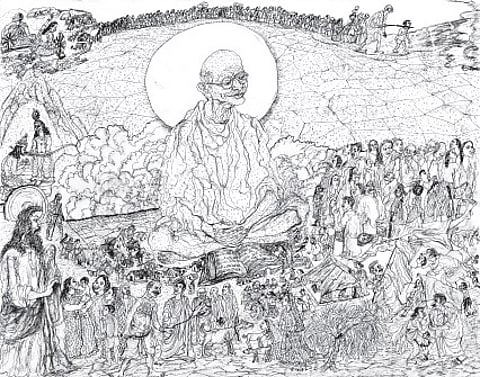
A glance at his drawings reveals a blend of magical realism and contemporary impressions of baroque paintings. Souvenirs of a once-romanticised Kerala rural life, invoking the Gandhian philosophy that “India lives in her villages”, fill his creations. Even with traditionally attired people and folk elements rooted in Kerala’s soil, his works resonate universally, captivating with their effervescent charm and human sentiment.
It’s unfortunate that one cannot ask Unnikrishnan about his works, the hidden meanings, his inspirations, and his musings. Shijo and Manoj recall their friend, bustling around his village, chatting with neighbours, the milkman, the tea shop lady, the librarian, on his morning walks.
“It’s probably this village life that inspired his works, things that stuck in his memory, his imagination, or his hopes for a peaceful future — all of these are reflected in his art,” Manoj observes.
For an artist who spoke a lot about various topics, he rarely mentioned his works, they say. The Buddha, Gandhi, Sufi saints, velichappadu (oracle), a mother figure resembling the Madonna, a clown, and theatre are a few familiar symbols that appear in his series.
These, Shijo explains, signify Unnikrishnan’s growing disquiet with contemporary society and its anxieties. “It might have been how he depicted his inner politics — his concerns for the future,” he adds.
In one of his frames, village women gather for an evening chat while a clown, mounted on a horse made of fragile paper-thin cloth, prances around. Others go about their daily routines. If one looks closely, among the villagers, a thief can be spotted scooting with a stolen hen.
“It’s everything — every aspect of seemingly mundane, rustic life. All from a vantage point, often as if the artist were observing from above,” Manoj reflects.
The duo believe Unnikrishnan is an artist worth discussing. His works, they add, deserve wider recognition. This conviction prompted them, and the Kerala Lalithakala Akademi, to organise a retrospective showcasing over a hundred pieces, including his earlier large-scale paintings.
“Popularity is not everything. Unnikrishnan proves that,” says Murali C K, the chairperson of the Akademi. “His life was dedicated to art. He rejected everything else, including the much sought-after fame that typically makes an artist known. Instead, he drew day and night. Such an artist certainly deserves recognition.”
Unnikrishnan had won several awards for his acrylic paintings before retiring from teaching. “But he was never comfortable with painting,” Manoj and Shijo say. “When his subconscious nudged him, he needed to pour it out, often without structure, a beginning, or an end. And in one sitting of four to six hours, he would finish it. Painting, which is more structured, never suited him.”
He found himself when he took up pen and canvas. ‘Stream of consciousness’ is a simple way of describing his works and artistic style, they say. Now, after his passing, Unnikrishnan’s works speak for themselves, revealing a master creator who lived for his art.
The exhibition will conclude on October 20