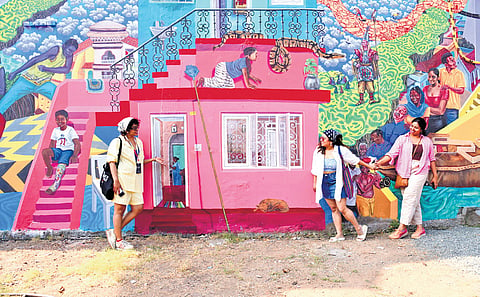

KOCHI: Kochi is gaining attention, not only as the gateway to breathtakingly scenic and prosperous Kerala, but also as the state’s cultural melting pot. This becomes evident through reports published by Lonely Planet and various other international travel magazines, as well as tour agencies. According to Lonely Planet, which ranked the city seventh among its Top 10 cities to visit, Kochi is a vibrant potpourri of art, culture, food, carnivals and festivals.
Then there is the Booking.com’s Travel Predictions 2026 report that has ranked Kochi among the top 10 destinations worldwide, making it the only Indian city to break into the list. It joins names like Bilbao, Manaus and Philadelphia, and reflects a growing global appetite for less-overdone places rich in culture, history and natural beauty. It is true, says Riyas Komu, artist and curator.
“Thrissur remains a Mofussil town that claims the cultural capital status because it hosts the state-run akademies. Cultural production is key to any place. Publishing is now decentralised across the state, while cinema and TV are mostly in Kochi.
Also, modern music production in Malayalam is Kochi centric. Art is a fully Kochi-centric phenomenon, and it is where a large amount of art production is happening in post-independent India. So, in terms of cultural production, Kochi is indeed a cultural hub. Biennale, Uru, Aazhi Archives, Kashi, Muziris Contemperory, etc, have turned it into a site of ideas and art production,” he says.
Riyas adds, “Unlike Thrissur, Kochi is a more cosmopolitan space closely linked with the global economies of cultural production, appreciation, and consumption. It has changed the art ecosystem of the subcontinent, and is expanding the horizon in radical ways for the rest of India.”
Agrees S Gopakumar, an architect and president of the Better Kochi Response Group (BKRG). “Kochi is a melting pot of different cultures and traditions. Unlike Thrissur, which banks much of its status as the cultural city on the Pooram and Pulikali, Kochi has become a hub of soft culture. A cultural scene that has more art, music, literature, dance and cuisine,” he says. This is a place where history sleeps, he says.
“It is a place that hosts different cultures, both national and international. Kochi has a colonial influence in terms of the Dutch, British, Portuguese and the Jews. The city has a rich heritage.” He points out how the Kochi corporation brought out a cultural policy that aims to incorporate culture into the city’s policy framework by integrating cultural aspects into education, transportation, inter-city collaborations, environmental management, resident programmes, ward initiatives, library networks, public events and community engagement activities.
“What is needed is more and more public participation. One shouldn’t always depend on the government to do things. Look how the Biennale is doing. We too launched a project that will see the largest mural project on the walls of the Naval Base. And the funds for the project are being raised through crowdfunding,” he adds.
Johann Binny Kuruvilla, founder of Kochi Heritage Project, is of the same opinion. “Kochi has always been different from all the cities in Kerala. Whatever happens in Kochi is a fusion. A lot is happening, whether it is with respect to art or culture.
For example, besides the Biennale, a big art event has been announced for January which will see 200 artists coming to Kochi. Kochi is regaining its place on the cultural map of the country. It was forgotten in the past. However, it needs to get a tag like Kozhikode, which was recognised as the city of literature tag, or Lucknow, the city of food,” he says.
