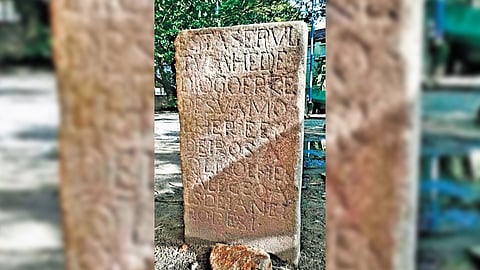

KOCHI: A stone inscription believed to be from colonial era has been lying neglected on the Fort Kochi beach walkway for nearly five years — exposed to foot traffic, sea air and, more recently, vandalism. The stone slab is located on the promenade, just past the Vasco Da Gama Square. Interestingly, it can be seen from the windows of Bastion Bungalow’s upper floor, where the state archaeology department maintains a wing.
Today, however, the structure is not so easy to locate, as vendors are using it as a platform to arrange goods. “Parts of its surface now show signs of damage as a result,” highlighted Raigon Stanley, Director of the Grey Book Museum and Archives. Before the walkway came to be, the stone slab, first discovered in 2002 near the Chinese fishing nets, was erected on the Square grounds, recalled nearby locals.
It was mounted in its current place during renovation works undertaken by the Cochin Smart Mission Limited (CSML) in 2021. “It was close on the heels of the pandemic, and so, not many were paying attention,” recalled Ibrahim Thaha, a history enthusiast. Still, owing to its presumed historical value, CSML officials, heeding the concerns of locals, refrained from pouring concrete directly over the structure and affixing it with the walkway’s tile works.
The move resulted in half the stone slab being buried beneath the pavement. Only a segment protrudes above the surface, leaving only half the inscriptions readable, said Raigon. Heritage activists in Fort Kochi told TNIE that they had repeatedly pressed the authorities to conserve this structure. “However, no action has been taken yet,” Thaha said.
A letter sent to the Archaeological Survey of India in 2021 came back with a response that the matter fell under the archaeology department’s jurisdiction.
However, when TNIE reached out to the latter’s director, E Dinesan, he said, “The state archaeology department is only entrusted with the conservation of monuments. And there are two in Fort Kochi and Mattancherry – Bastion Bungalow and Ariyittuvazhcha Kovilakam.”
“The said stone slab is not a ‘monument’ and therefore does not come under the purview of the department,” the director added. However, Ayana Antony, a doctoral researcher who focuses on the Portuguese era, told TNIE that the slab is indeed of historical significance. “It is a tombstone, or parts of it,” she said.
The inscription on the slab reads: Este sepultura he (é) de Diogo fr__ e de sua molher (mulher) e erdeiros ( herdeiros) _. faleceo a 15 de janeiro de 81. According to Ayana, this translates to: This grave is of Diogo, his wife and his heirs. (The next line is not clear). The person died on January 1581. “It is unclear what century ‘81’ is from. But given that the inscriptions are in Portuguese, we can assume it is of their period,” the researcher said.
Indeed, when TNIE referenced Malabar: Christian Memorials by John Cantwell Roberts and N P Chekkutty, it became clear that the tombstone is indeed from 1581 and belonged to Diogo Perez. The slab’s discovery was no accident, highlighted Raigon. “It took five years of painstaking labour and research,” he said. “Now, it’s disheartening to see such historically significant structures lying around, he added.
Indeed, this neglect is not without precedent. As TNIE reported last month, several similar artefacts relocated to the Bastion Bungalow premises in 2021 remain neglected. “Even with those stones, the department maintained that they are not historically significant,” Thaha recalled.
Ayana said the tombstone slab and other artefacts in the region are very important as they provide a window “to study the social history of the Europeans in Kochi.”
