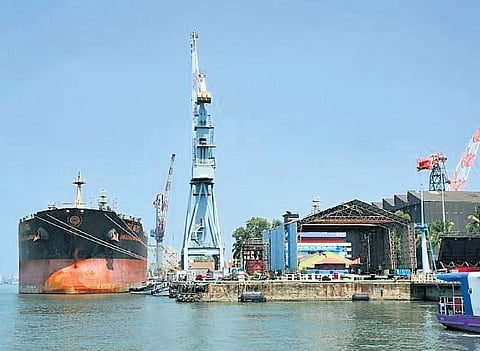

KOCHI: As India moves to expand its shipbuilding capacity and figure in the world’s top 5 shipbuilding nations by 2047, Cochin Shipyard Limited (CSL) is one of the public sector yards well placed to benefit from this investment push and policy overhaul.
Speaking at the COMARSEM 2026 maritime seminar in Kochi recently, DG of Shipping Shyam Jagannathan explained, “The renowned focus on shipbuilding was driven by the need to quickly scale up domestic capacity and reduce India’s dependence on foreign fleets,” especially given the geopolitical shifts of the time.
Last year, the central government rolled out a `69,700+ crore maritime revival package. Of this, close to `20,000 crore has been earmarked for expanding shipbuilding infrastructure. CSL, which now harbours ambitions to capitalise on Kochi’s legacy shipbuilding brownfields, aligns closely with this development scheme.
Shyam said strengthening existing yards was “critical because they already had skilled manpower and operational experience. Greenfield yards take time. Strengthening what already exists allows capacity to come online much faster.”
Another policy change likely to benefit CSL is the decision to treat large commercial ships as infrastructure assets, which alters access to long-term finance.“Once ships are recognised as infrastructure, access to capital changes completely. Like, in terms of tenure, cost and risk perception,” the official noted. This may invariably boost public sector demand.
The government also plans to aggregate demand through state-owned entities, with over 350 vessels proposed to be built domestically over the coming years. “With this initial push, private players can follow with confidence,” the DG Shipping said.
CSL, which operates across shipbuilding, repair and maintenance, is seen as well placed to benefit from this demand.
In response to Shyam's statement, a senior offficial of Cochin Shipyard said, "CSL being a leading shipbuilding and repair yard in India, is well positioned to capitalise on the new initiatives of the Government of India."
"The company's expertise in niche vessel construction and shiprepair make it an ideal partner for the government's maritime push," the official said, adding, "CSL is fully aligned with the schemes and policies that have been promulgated by the Government of India and is hopeful of benefiting from the same, as we all strive to position India as a global Shipbuilding hub."
Water Metro figures in green shipping push
During his address, DG of Shipping Shyam Jagannathan also spoke about the Centre’s green maritime roadmap, stressing that sustainability would be central to future expansion. “Green shipping is not negotiable anymore. It is an investment in our collective future,” he said.
In that context, he referred to the experience of Kochi Water Metro, noting that operational exposure to electric vessels and charging infrastructure would be relevant as India transitions towards hybrid and low-emission fleets.
In response to Shyam's statement, a senior official of Kochi water metro said, "We welcome the DG Shipping's comment. As India's pioneering electric public water system, KMRL's role is already expanding under a Union government initiative to replicate the water metro model in about 20 inland and coastal cities in the country. In addition to feasibility studies operational expertise, we can also offer guidance on ironing out the finer nuances of running a water system, and we look forward to our contributions on that front as well."
The two-day COMARSEM 2026 deliberated on issues shaping the future of the maritime sector and India’s aspirations to emerge as a global maritime powerhouse.
Global ownership
India’s ownership of ships globally is only about 1.7 per cent, and on shipyard output, less than 1 per cent of global production.
This is despite almost 95 per cent of its trade (by volume) and 70 per cent (by value) moving via sea
