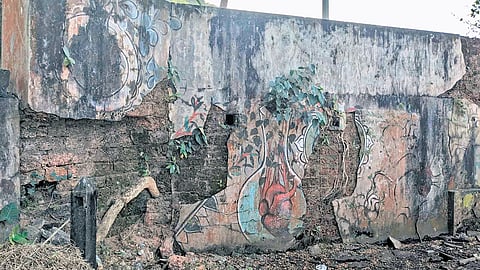

KOCHI: Visitors to Fort Kochi often arrive with an unspoken question: where’s the fort? There is none to be seen, save, of course, for a centuries-old artillery bunker tucked away on the beachfront, largely out of prominence.
The structure is believed to be a remnant of a bastion of Fort Emmanuel, built by the Portuguese in 1503. While historians continue to debate its precise origins, there is consensus on one point: the building is historically significant.
Today, however, the bunker is in a dilapidated state, prompting concern among locals that it may collapse any day.
“This colonial-era structure once functioned as an artillery bunker to defend against invaders and was later used as an optical telegraph tower to convey vital messages. Years of neglect have ruined it,” said Raigon Stanley, director of the Grey Book Museum and Archives.
Indeed, the structure now visibly leans forward, with large portions of its outer layer cracked or peeling away, exposing the laterite bricks beneath. “It could collapse anytime,” Raigon warned.
The decay extends beyond structural damage. During a recent visit, TNIE found the bunker defaced with graffiti and covered in moss due to prolonged neglect.
This ruination is not limited to physical deformations, but has also encroached into people’s perception of its importance.
“It’s a sad sight,” said Raphi, a staff member at a nearby shop. He recalled how the bunker was once plastered with posters for a religious event.
“No one dared remove them because of its association with a religious group. They remained there until a few history-conscious people stepped in.” Vandalisation of heritage structures in Fort Kochi has become increasingly common, Raigon noted. “Defacing protected structures is a serious offence under Indian law, with stringent penalties. But who is acting on it?” he asked.

Given its present condition, the bunker’s historical importance is far from obvious to visitors. “Locals might recognise it, but a first-time tourist wouldn’t,” said Sunil, a visitor to Fort Kochi. “In its current state, it could easily be mistaken for a garbage dump,” he quipped.
Society, sees his point. “We have repeatedly urged authorities to install proper signboards explaining the history of each heritage structure, but there is little interest,” he said.
Although a small information board is affixed to the structure, it is barely visible amid the defacement. Even then, the details it carries are inaccurate, pointed out former Kochi mayor K J Sohan, a heritage enthusiast and member of the Kerala chapter of the Indian National Trust for Art and Cultural Heritage.
“It is not a gunnery as is listed on the board, but a searchlight tower. It was used to guide the artillery battery set up along the coast to find the approaching ships and fire at them,” Sohan.
According to him, the structure was once sturdy enough to withstand cannon fire aimed at extinguishing its lights. “So, a little weathering won’t bring it down. But of course, conservation of historical buildings is indeed necessary,” he added.
As for Fort Emmanuel itself, he said it likely stretched from Bastion Bungalow to the southern end of the beach, near where the Indian Navy’s gunnery school, INS Dronacharya, now stands.
“Several bastions once formed part of the fort. Most are now submerged or lie beneath buildings constructed over centuries,” Sohan said.
Save for this defaced one, as Raigon said.