
KOCHI: The word museum elicits the image of a building housing various spacious halls with artefacts from ancient times displayed in glass cabinets. A space that is completely impersonal, with the visitor moving around observing these artefacts merely as an onlooker. However, in what can be described as a first-of-its-kind initiative, Kerala’s Muziris Heritage Project has introduced the concept of a living museum.
But what is a living museum? Sharon Veetil, managing director of Muziris Projects Limited, says, “A living museum provides a visitor with an immersive experience. Take, for example, the Cheraman Juma Masjid at Kodungallur. The mosque is believed to have been built in AD 628 and is considered the earliest one in India. The mosque was renovated by the Muziris Heritage project and is now used by the community to hold prayers. This is what the concept of living museums entails.”
Explaining further, he says the Muziris Heritage project’s living museum features digital interactive products and indigenous objects, combined with live demonstrations of traditional construction techniques, basketry, cuisine, seed crafts, woodcarving, and music and dance performances. “The project addresses key questions concerning the relationship between indigenous intangible cultural heritage and the environment, particularly in the context of bioclimatic architecture and the cultural creative industries,” Sharon says.
The Living Museum aims to make available to national and international audiences the artisanal, musical, and ritual intangible heritage of the Muziris zone, and maintain architectural edifices that emphasise indigenous construction techniques using wood and laterite.

The Muziris Projects managing director says the initiative integrates a diverse group of conserved religious monuments that collectively represent the region’s long history of cultural exchange and religious coexistence.
“These monuments function as living museums, where architectural heritage is inseparable from ongoing ritual practices, oral traditions, festivals, music, and community life,” he points out.
The living ecomuseum is another innovative concept. The shops at Paliam in North Paravur — conserved as part of the Muziris Heritage Project — function as a living ecomuseum reflecting the everyday economic life of the historic Muziris region.
“Traditionally, these shops were integral to the local trade network, supplying essential goods and serving as spaces of social interaction within the community. Their conservation preserves not only the architectural form and spatial organisation of vernacular commercial structures, but also the intangible practices associated with local commerce, exchange, and craftsmanship,” says an official with the Muziris Heritage project.
As a living ecomuseum, Paliam Shops continue to support small-scale traditional occupations, artisanal production, and community-based trade. “The adaptive reuse of these spaces allows for live demonstrations, sale of locally produced goods, and interpretation of historical trading practices that once connected Muziris to wider Indian Ocean networks. Visitors experience the continuity of economic traditions through direct engagement with artisans, traders, and everyday practices rather than through static exhibition,” the official says.
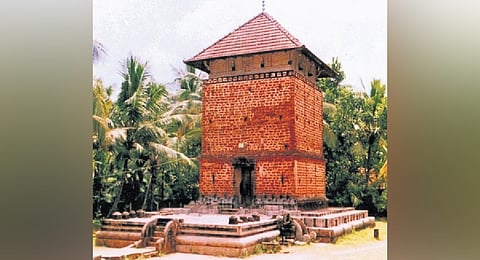
Some of the religious monuments that have been conserved under the Muziris Heritage project are the Holy Cross Church, Chendamangalam — a historic church established by Jesuit priests (1577 CE); Marthoma Pontifical Shrine, Azhikode (Kodungallur) – one of the earliest Christian sites in Kerala linked to St Thomas the Apostle; Manjumatha Church/Basilica of Our Lady of Snow, Pallipuram; Kottakkavu Church, Paravur; Bhandarappura of Kodungallur Bhagavathy Temple; Keezhthali Siva Temple (ruins), Iranikkulam Mahadeva Temple, Paravur Synagogue (Jewish Synagogue Museum); Chendamangalam Synagogue (Kerala Jews Lifestyle Museum); and Cheraman Juma Masjid, Kodungallur.
“All of these sites are conserved not just as static architectural landmarks but as living heritage spaces, places where rituals, festivals, and communal practices continue to be performed, maintaining living traditions. These interpretation centres, museums, and interactive exhibits invite visitors to understand the cultural, historical, and socio-religious significance of the site. Another point behind the living museum is to promote community engagement and educational programmes. These emphasise intergenerational transmission of intangible cultural values,” Sharon says.