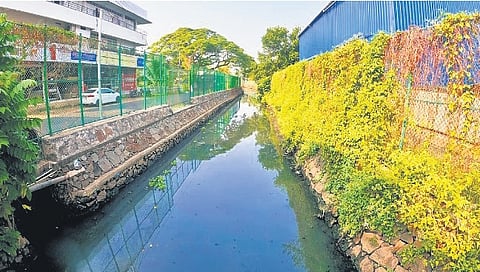

KOCHI: The possibility of parts of Kochi — including low-lying coastal stretches such as Vypeen and Chellanam — slipping below sea level by 2050 is emerging as a growing concern for planners and residents alike.
Climate studies have repeatedly flagged the vulnerability of the coastal city to rising sea levels, tidal flooding and land subsidence, raising urgent questions about how Kochi can safeguard itself in the coming decades.
Now, the Kerala government’s ambitious plan aimed at strengthening the city’s flood resilience. The `3,716-crore Integrated Urban Regeneration and Water Transport System (IURWTS) project proposes to restore and rejuvenate six major canals across Kochi, improve water flow and make them navigable — measures expected to reduce tidal flooding and chronic waterlogging.
Sanctioned by the Kerala Infrastructure Investment Fund Board (KIIFB), the project covers the restoration of the Thevara-Perandoor canal (9.88 km), Chilavannoor canal (11.15 km), Edappally canal (11.23 km), Thevara canal (1.41 km), Konthuruthy canal (0.67 km) and Market canal (0.66 km).
A study titled Sea Level Rise Scenarios and Inundation Maps for Selected Indian Coastal Cities by the Centre for Study of Science, Technology and Policy (CSTEP) has warned that sea levels along India’s coast have been rising based on past climate data and are projected to continue increasing through the century. It identified the airport area, Ernakulam Wharf, Fort Kochi Beach and Subhash Bose Park among the potential vulnerable locations in Kochi.
Scientists note that storm-surge-prone regions such as Vypeen and Chellanam face the greatest threat. “The extreme rise in sea levels will submerge storm-surge prone areas such as Vypeen and Chellanam. Over the years, the carrying capacity of backwaters has declined and the frequency of tidal flooding has increased.
We are also facing the issue of land subsidence,” said Dr S Abhilash, director of the Advanced Centre for Atmospheric Radar Research at Cochin University of Science and Technology. Experts say restoring canals through dredging and desilting can significantly improve drainage in a city interlaced with waterways, though a combination of measures may be needed to tackle long-term flooding risks.
“Water management helps prevent waterlogging in every city. In Kochi, canal restoration can help. But a system of pumps should also be put in place to prevent flooding,” said S Gopakumar, president of the Better Kochi Response Group.
Drawing parallels with Amsterdam, where large parts of the city lie below sea level, he said Kochi should also consider infrastructure such as pumping systems and canal widening to manage water levels.
Apart from canal rejuvenation, the IURWTS project envisages rehabilitation of slum dwellers along canal banks, establishment of sewer networks and treatment facilities to prevent direct discharge of waste into canals, development of jetties for water transport, and creation of tourism-friendly waterfront spaces.
The emphasis on improving canal navigation is significant as only about 20% of Kochi’s extensive waterway network is currently used for transport, despite inland waterways being one of the cheapest and most sustainable modes of urban mobility.
