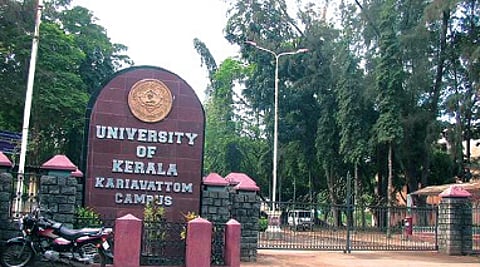

THIRUVANANTHAPURAM: Faculty and researchers at Kerala University’s Kariavattom campus have taken it upon themselves to replace acacia trees with indigenous species and study its impact on the biodiversity on the campus.
The acacia trees, which seem like innocuous green shade to untrained eyes, drain water sources and cause pollen allergies. Moreover, with wind carrying the pollens fast, acacia leaves little space for any other vegetation.
A Biju Kumar, Associate Professor, Department of Aquatic Biology and Fisheries, says, “Restoration will be done in phases. A team of research scientists and faculty from various departments will document the existing biodiversity, and a change in biodiversity once the indigenous trees are planted. Changes in soil nutrients will also be assessed. The programme is an initiative of the Campus Development Committee. It will be executed with the help of the Social Forestry Department.”
The acacia plantation was introduced by the Social Forestry wing in the 1970s. Even as acacia trees spread like cancer, few understood its implications on the environment. Decades later, with the campus conquered by acacia, the University woke up to the acute water shortage and the smattering pockets of indigenous vegetation. Even cash-yielding indigenous species like mango and coconut were limited to isolated areas, as acacia took root.
As part of the project, indigenous species like mango, jackfruit and sapota as well as cash crops like teak and mahogany will replace acacia. To ensure effective eco-restoration and complete documentation, the committee has brought together faculty from seven departments. These are Aquatic Biology and Fisheries, Botany, Chemistry, Computational Biology and Bioinformatics, Environmental Sciences, Geology and Centre for Geo-informatics as well as Zoology.
Eco-restoration is considered to be one of the most efficient tools to arrest environmental degradation.
However, since it alters the functioning of the ecosystem, to ensure that the impact is positive, the project needs to be closely monitored for years. The participation of experts from different departments should ensure this.