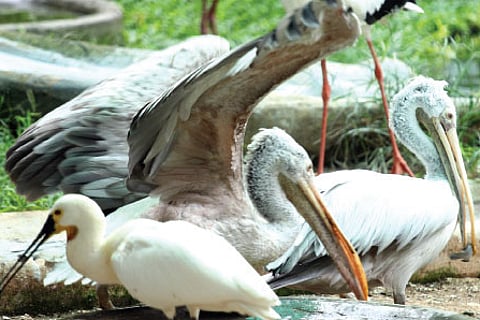

The City Zoo has over 50 species of birds, including several rare ones, but a plan to provide them with more space by building bigger aviaries is yet to get the final nod from the Central Zoo Authority (CZA).
The Director of Department of Museums and Zoos, B Joseph, said: “According to a Supreme Court directive, all forestry operations should be backed by a master plan approved by a competent authority. Thiruvananthapuram Zoo’s master plan is still in the draft stage. A bigger aviary is being planned. We have been suggesting design ideas to the Central Zoo Authority, and is waiting for its approval.”
An aviary, inaugurated in 2009, has just about sufficient space for the zoo’s water birds. If an idea suggested by the zoo authorities is implemented, the birds of prey will be moved to this aviary. Another aviary stretching over a larger area will be constructed for the water birds. The hitch? While it looks good on paper, it will need the approval of the CZA. Earlier, ambitious plans like a walk-in aviary were shot down by the CZA.
As the plans take time to materialise, the zoo authorities are resorting to other measures like bird exchanges to resolve the issue of crowded aviaries. As part of a barter deal, the City Zoo has given away Brahminy kites, ostriches, brown fishing owls, black swans and golden pheasants to the National Zoological Park in Delhi. The Delhi zoo will be sending painted storks, red jungle fowls and white ibises to Thiruvananthapuram in return.
Meanwhile, CZA is in the process of preparing a list of surplus animals in zoos, which is expected to facilitate more animal exchanges. The vultures in Thiruvananthapuram, which seem too huge for their confines, might be gifted to another zoo. However, the barter deals are yet to make a visible difference. The kites in the zoo have the most congested bird enclosure. Ten Brahminy kites and 11 pariah kites huddle together like brooding philosophers in a single shelter. These are rescued birds. The CZA guideline requires all rescued wild animals to be rehabilitated back in the wild or in a rescue centre after treatment. Releasing them into the wild is out of question, as the kites are either juvenile or have broken wings, lesions on the foot, blind eyes or problems in their claws.
Moreover, the birds have grown accustomed to their captive life and have lost the ability to survive in the world outside their cages. For instance, the Himalayan vulture in the zoo, which is blind, will go hungry if it is not hand-fed.
Despite its limitations, the Thiruvananthapuram zoo is the only rescue home in the city equipped to shelter wild animals and birds. There is goodwill in sheltering every injured or juvenile animal (even a Brahminy kite belonging to the ‘Least Concern’ category of the IUCN Red List). More reason that the zoo shouldn’t delay its infrastructural changes. The birds are waiting.