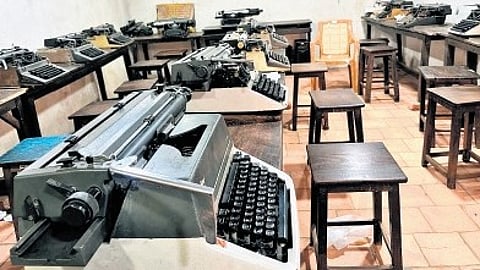

THIRUVANANTHAPURAM: As one ascends the wooden stairs of Fort Technical Institute, the clickety-clack of typewriters — once the soundtrack of ambition and hustle — starts to dominate the air. For 105 years now, the institution in Pazhavangadi has been tutoring students on typewriting skills and, in the process, keeping alive a legacy.
“The institute was started by my grandfather Appu Iyer with just two typewriters in 1919,” recalls Subramanya Iyer, the institute’s custodian. It has remained relatively untouched since, save for, of course, very necessary modifications.
“He was a typist at the government Secretariat,” Subramanya continues. “He started this as a means for my grandmother’s sister, a widow, to earn a living.”
When it began, there were no other typewriting institutes in the area and so, students came from even distant places to learn. “Between 1980 and 1986, about 600 students were learning here in multiple batches,” Subramanya says.
Back then, typewriters were imported from foreign countries and brands like Royal Typewriter and Imperial Typewriter were the vogue. “Only English typewriting was available at the time. There were no options for Malayalam or Hindi. Later, companies like Remington, Halda and Godrej started producing typewriters in India, bringing more options,” he adds.
Malayalam typewriters were introduced later. But many of them had different keyboard layouts. To standardise it, a proposal was submitted to the government, which eventually led to the creation of a uniform Malayalam keyboard layout. However, today, typewriter production has waned because offices no longer orders them.
During its heydays, classes at the institute were conducted every day except Sundays, from 6 am to 8 pm, with each batch having an hour-long session. Along with typewriting, it also offered courses in shorthand, double-entry bookkeeping, secretarial practice, and more.
The fee for typewriting classes was initially otta kaal anna, and later, Rs 1.
“In the past, government jobs were filled through direct recruitment. Government offices and institutions used to approach the institute to fill typist posts,” Subramanya says.
Sadly, computers have eclipsed typewriters. But that has not stopped people from learning typewriting. Currently, about 60 students are enrolled at the institute, and there are 20 machines here — three for Malayalam, one for Hindi, and the rest for English.
“Our students still secure government jobs. Some of them have gone on to work at places like the Secretariat, Travancore Titanium Products, ISRO, and many other government offices,” Subramanya says.

According to him, typewriting skill holds relevance even today as “those with training can type 10,000 keystrokes in one hour. It can also help increase typing speed on a computer keyboard.”
But the sad reality is that with computers becoming the preferred option at most government and private offices, typewriting institutes are shutting down across the state.
“The government has decided that computers are sufficient, and typewriting is no longer essential. However, the state government still maintains typist positions in various departments,” Subramanya points out.
Elaborating further, he says, “Even today, candidates with SSLC and KGTE (higher/lower) qualifications are being recruited for entry-level typist jobs through the PSC route. So, the question is: if people are not coming to learn typewriting, how will the government fill these positions? This situation clearly shows that learning to typewrite remains important.”
Whatever the future may hold, the Fort Technical Institute remains a living memory of the past.
Subramanya holds firm to the belief that typewriters will endure, saying, “As long as typewriters remain in various government institutions across Kerala, they will continue to be relevant. And this institute will keep guiding future generations.”