
THIRUVANANTHAPURAM: Have you ever wondered, as you walk down a street, how many stories that place may hold? At every corner of Nedumangad, one of Kerala’s oldest towns meticulously planned, there are tales that played important roles in shaping the culture of the state.
According to historians, to form a community and town at Nedumangad, planners needed traders and various other groups. So they settled people from Tamil Nadu. For example, they brought in the Muslim community from Tamil Nadu, who were fine warriors and experts in Kalari, for security. Each of these communities were provided with their own streets and other facilities, the remnants of which can be seen even now. There are community-specific nooks and crannies, temples, and even graveyards at Nedumangad.
Today, the place is a lively blend of Tamil, ethnic, and tribal cultures. “Nedumangad, previously known as Ilavelloor Nadu, is nourished by two rivers, which are Karamanayar and Killiyar. It is like how Mesopotamia lies between the Euphrates and Tigris rivers. Historically, the southern side of Karamanayar was called Velloor Nadu, and the northern side was Ilavelloor Nadu. The term ‘Vel’ refers to agricultural or irrigation areas.

In the 9th century, during the Ay dynasty, the name changed to ‘Venattunallur Nadu’, reflecting its integration into the princely kingdom of Venad, which was centered around Kollam. Nedumangad, located in the southern part of Venad, came to be known as Ila Venad. During the feudal period, it acquired the special name ‘Perakam’, meaning grandson’s place. The Venad kingdom was ruled by the Attingal queens, with Kollam under the eldest son and Kottarakkara under the second generation. Perakam was designated for the third generation, specifically the grandson or granddaughter,” says Vellanad Ramachandran, who has brought out the book Nedumangad Noottandukaliloode.
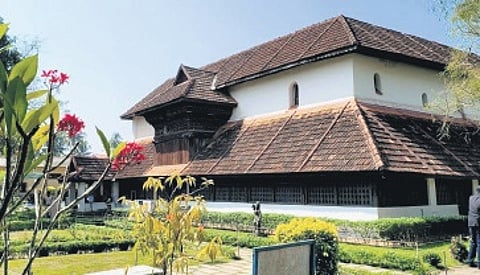
“Umayamma Rani, the regent queen of Venad, used this area as a retreat. About two kilometers from Perakam is Karipur. Since Perakam lacked administrative facilities and required crossing a stream to reach the palace, they cleared the Nedumangad forest and built a palace there, which became known as the Nedumangad Koyikkal Palace. The town of Nedumangad grew around this palace,” he says, adding the meaning of Nedumangad is the forest (Kadu) of Vishnu (Neduman).
The book, Nedumangad Noottandukaliloode presents a comprehensive history of Nedumangad, the capital of the princely kingdom of Perakam and the fourth route of Venad, spanning from the Neolithic period to the first election in Kerala.
This extensive work consists of 33 chapters and 1,503 pages, supported by over 500 references and 300 interviews. It includes a lot of historical sources, such as ancient manuscripts, petroglyphs, palm leaves, and wall records. The book is published by the Kerala Bhasha Institute. Ramachandran, who previously entered the Limca Book of Records for writing the largest panchayat history in India, dedicated five years to the book’s research.
“The book is classified into political, cultural, and developmental history. I do not claim that it includes all of the history because history is always incomplete. However, I have utilised the maximum available materials to write as accurate as I could. It is written academically with evidence, and it has already become a topic of discussion in colleges,” he says.
The book is the author’s way to keep the stories around Nedumangad safe for posterity, he adds.