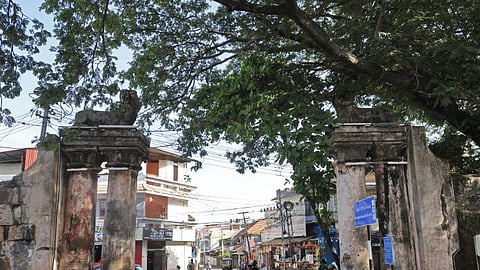

Mohan Nair is a proud Trivian whose passion for the city has led him to pen the book ‘Ente Mohana Nagaram’. This affection for his hometown has been making him uneasy everytime he moves around the monumental Fort area of the city, where mindless urban spread threatens to strip the city of its prime identifying landmark.
But on Monday, he was literally driven to the wall when he found the Simha Kotta, towards the southern side of the fort area, standing strangled and suffocated amidst a pile of waste at its base and haughty encroachments on either side of the wall defacing the wall of its historical relevance as a monuments that marked the valour of Travancore.
The structure, which was part of the fort even during the times of Anizham Thirunal Marthanda Varma, was refurbished in the 19th century to portray the valour of the kingdom, which takes pride in being militarily undefeatable on several counts.

“It was a heart-rending scene. I couldn’t help but click it and post it on my Facebook feed. A similar state of affairs can be seen across the fort area, in its other strategic parts too, like West Fort, Vettimurichakotta, and other main corridors and even along the western wall," he says. "Not only have people made the fort wall part of their homes or offices, but there are several places where waste dumping and waste burning are rampant.”
Mohan and a group of local residents, as well as heritage enthusiasts, organised a demonstration near the West Fort area about 10 days ago to flag the issue. “The official response to the issue, especially from the corporation’s side, has been cold and in fits and starts,” he says.
Dinesan E, director of the state department of archaeology, says the conservation of the East Fort area, which received heritage monument status in 1985, is a huge challenge for the department among all the 192 such monuments across the state.
“We have employed four watchers just to monitor the fort area and the wall and report on any hiccups to its upkeep,” he claims. But the issue gets graver with the area witnessing heavy traffic, encroachments, and rampant waste dumping and burning.
“Our contention is to get the fort wall area properly demarcated as a heritage zone, whereby about a 3-metre stretch on the sides of the wall will be encroachment-free and waste-dumping-free zones. The efforts for this had kicked off in the 2012-13 period, but it was only in 2021 that the first notification came up to clear encroachment from the area around the wall. It has been done to some extent, but there is a lot more to be done,” he notes.
“The extent of construction work going on around the walls is a hurdle. Any such activity has to take note of the heritage value of the structure. We have embarked on the conservation work of the fort area around Attakulangara. Work is about to start at the West Fort area too, where part of the wall has come down. The conservation items to be used are all traditional, and hence we need to wait for the rain to cease.”
Despite the archaeology department’s efforts, a discord between departments seems apparent in the issue with the corporation being lukewarm in its action against the encroachments and in the waste dumping issue.
The public attitude to such a heritage structure is also to be blamed, with people choosing to build their dwellings on either side of the wall, making it part of their construction or to gather the waste around it and burn it haphazardly. “There has to be some awareness, some civic sense,” Dinesan sighs.
Also, the crazy surge of traffic in the area with no regulation to spare some distance on either side of the wall proves detrimental to the health of the structure, which is over 200 years old.
“We see a lot of efforts put into conserving such monuments across the world. Why is this one, which literally is the identity of the city landscape, treated with such indignity?” asks Mohan.