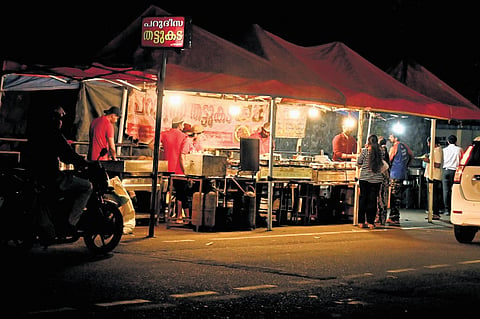

THIRUVANANTHAPURAM: For Gayathri and her friends from the Government College for Women, street-side eateries are part of their everyday lives. “We have been regulars at these thattukadas. Most of us can’t afford cafes or restaurants every day. Here, we get a dosa, rasavada, and omelette combo for just Rs 50 to 80. Also, it is very filling,” she says.
She had come with a group of friends to a popular eatery near Cotton Hill School, enjoying their favourite meal while standing by the roadside, laughing and swapping stories.
Vishnu K, who works as a designer at a private firm, said it’s not just students who rely on these stalls but also many working bachelors. “After office, there is hardly any energy left to cook or clean. Most of us from my workplace stop by these places to buy food. It’s quick and convenient. There’s no waiting time like at a restaurant,” he says.
Across the city, it’s common to see temporary sheds and carts lighting up the streets every evening. For years, these makeshift eateries have been part of the city’s evenings, nightlife, and food culture.
According to data from the Economics and Statistics Department, the city had over 1,200 street food vendors as of 2016. With the rise of nightlife, eating out culture, and infrastructure growth, this number has likely increased.
Recently, however, several of these stalls were shut down by the police following complaints about encroachment and unauthorised operations. The move triggered mixed reactions.

The issue
“From around 3.30pm, they start occupying the city roadsides. Even if it’s temporary, it creates traffic snarls. It’s becoming an issue not just for vehicles but even for pedestrians. There is no control,” says P Jayadevan Nair, president of the Fraternity of Residents’ Association Thiruvananthapuram (FRAT).
Following multiple complaints from residents’ associations, the police evicted 23 unauthorised food stalls along stretches such as Sasthamangalam, Vellayambalam, and Vazhuthacaud.
The move prompted food truck operators to approach the chief minister’s office seeking intervention. Soon after, they were allowed to resume operations, albeit under specific conditions.
“After our repeated complaints, the corporation and police took action. But now they have resumed operations, So, what’s the point?” asks Jayadevan.
“Near Cotton Hill School, where around 12,000 students study, the roadside is often occupied by 10–15 vendors, leaving little space for students to walk safely. The decision to introduce designated vending zones and fixed space limits is a welcome change, but it needs to be implemented quickly.”
He also points out that the issue extends beyond food stalls. “Along the Poojappura–Karamana stretch, several furniture outlets are using the roadside for business. We have submitted complaints about that too,” he adds.
Impact on vendors
While residents see the move as necessary, for vendors, the sudden crackdown has meant lost income and uncertainty.
“After one week of closure, our sales dropped sharply. The notice said it was because we were causing traffic blocks, but we have always tried to manage it responsibly; we even have a security person to control parking.
The day before the eviction, officials just told us not to open the next day. Around 10–12 people work here, and their salaries were stopped for that week. It happened right at the start of the month when everyone had EMIs to pay,” explains a thattukada manager who did not wish to disclose his name.
Out of 10 shops in his area, only five have resumed operations. “Most of us are ordinary people who depend on this for our livelihood,” he adds.
Another vendor from the Vazhuthacaud points out, “We have been operating here for years with proper licences and within limits. We set up in the evening, work till night, clean the area, and leave. But some don’t follow that. They leave their vehicles or carts overnight and never clean the space properly. I think that’s what creates trouble.”
Fairness and hygiene
Meanwhile, the police and Food Safety Department have raised concerns that many of the city’s wayside eateries are being operated under benami names, allegedly by big restaurant owners.
Food vloggers in the city share similar concerns.
“Near MG College, the so-called ‘food streets’ are operating without any licence. The idea of a thattukada was always about offering something affordable. However, now almost 50 per cent of these stalls are run by big hotels, selling at the same prices as restaurants. People end up paying more for smaller portions, served in unhygienic cutlery,” says Niyadh Basheer, a city-based food vlogger.
“Creating food zones would help control this and allow people to explore authentic, affordable stalls,” he adds.
A call for balance
“We see this as a positive step towards better regulation. We can’t support illegal roadside encroachments,” says Rasis R S, founder of Trivandrum Indian, a Facebook community.
“This is not just about the three stretches mentioned; such issues are common in beach areas and tourist spots too. For a developing city, maintaining order in public spaces is important. When we ran a poll on our page, almost 90 per cent of respondents, including food vloggers, supported the move, saying regulation is necessary. We are also planning to organise a campaign on road encroachment with Biju Prabhakar IAS,” he adds.
In their public poll’s comment section, most people supported the footpath clearance while also backing the idea of dedicated vending zones.
Looking ahead
Even those affected believe that a structured system could work — if done right. “Dedicated vending zones could help,” says one vendor, “but only if they are easily accessible. If customers can’t stop by easily for a quick meal, it won’t really be a thattukada anymore.”
For regulars and food enthusiasts alike, these stalls are more than just quick food
stops — they are part of everyday life, memory, and camaraderie. As the city moves towards regulated vending zones, many are ready to adapt, hoping that both vendors and the corporation will preserve the identity of these spaces maintaining hygiene, managing waste responsibly, and caring for the environment, while keeping alive the warmth and flavour that make Thiruvananthapuram’s thattukadas what they are.