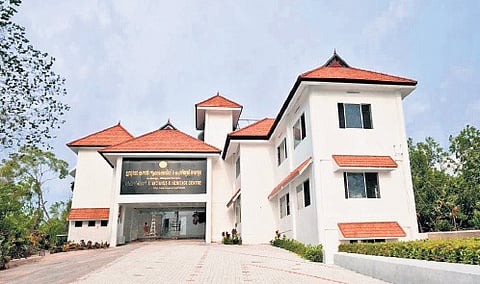

THIRUVANANTHAPURAM: Palm-leaf manuscripts from across Kerala — documents of yore that carry the story of how life and culture took shape over centuries in the state — are finding a new, spacious home in the city.
Spread over an acre, the International Archives and Heritage Centre (IAHC), inaugurated on the Karyavattom campus of Kerala University, is set to be the largest repository of palm-leaf manuscripts in India.
“Kerala reportedly has the largest collection of palm-leaf manuscripts from as early as the 14th century, with over a crore documents in official safekeeping alone,” says Parvathy S, director of the Kerala State Archives Department.
About 80 per cent of this is in Thiruvananthapuram, stacked at the archives office here and the Central Archives at West Fort.
Most of it is the ‘Mathilakam Rekhakal’, the documents on administration during the rule of the kings of erstwhile Travancore over the last 300 years.
“There are over 60 lakh palm-leaf manuscripts linked to this segment,” says archaeology department director E Dinesan.
A similar stock of palm-leaf manuscripts, though not of this magnitude, is kept at Kochi and Kozhikode facilities of the archives department.
The IAHC will house a one-stop study and research centre in a 22,000sq.ft facility for all the manuscripts in the domain of state archives.

Furthermore, exchanges would be organised with the nearby Oriental Research Institute and Manuscripts Library of the Kerala University, where scientific and literary-based manuscripts are kept.
“That will be a unique proposition because the university’s manuscript facility, just near the IAHC, houses some of the rarest knowledge-based documents on the state’s history, literature, astrology, Ayurveda, etc. And at IAHC, it will be mostly administrative documents as old as 500 years. So, for a researcher, the study will be wholesome — from all walks of yesteryear life as recorded in the palm leaves,” Dinesan explains.
“The centre will aid research in manuscripts, history, and archaeology, and can be accessed by academics, students, and enthusiasts.”
Officials hope the centre will be fully functional by mid-2027. “As of now, we are getting the manuscripts in the Central Archives as well as those with the archives department ready to be shifted to the new centre. Once that is done, we will aim at their conservation in the new facility,” says Parvathy.
“The capital’s collection itself will be the major chunk of the total stock, the remaining of which, from Kochi and Kozhikode, will be shifted in due course.”
The facility, which has received a `6-crore grant from the state government, is said to be the answer to a requirement to bring documents from across Kerala under one roof.
Earlier, conservation of manuscripts was a concern, with them being kept in a congested manner and research facilities less able to decode the information in the manuscripts.
The IAHC will have standardised facilities such as a conservation lab, digitisation lab, and facilities for study and perusal of the documents, according to officials.
“Some of the documents have been deciphered, and some are being done. What is required now is to employ machine-reading techniques in deciphering the documents that are already digitised,” says Dinesan.
“The palm-leaves are in ancient scripts like ‘Vattezhuthu’, ‘Kolezhuthu’, ‘Malayanma’, etc. Such a feasibility study, for use of AI and related technology in reading digitised manuscripts, is being done now.”