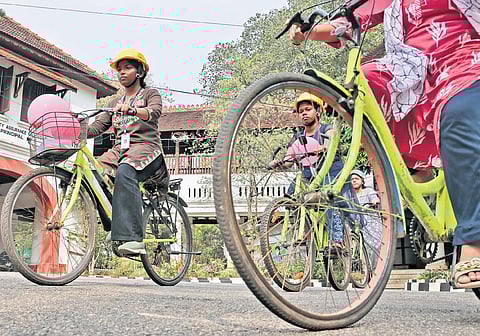

THIRUVANANTHAPURAM: For the past five days, by 3pm, a line of hesitant yet eager first-time riders gripped their handlebars at the ground of Government College for Women, waiting their turn. As the trainer let go for a second longer than expected, a wobble turned into a balanced glide and another rider had found her balance. This was part of SheCycling, a bicycle literacy campaign that aims to ensure every student and teacher on campus learns to ride this year.
Cycling here is no longer a childhood memory or a missed chance but a skill being claimed with intent. SheCycling is the Indian chapter of BYCS, an Amsterdam-based global NGO that supports community-led urban change through cycling. It is being implemented under the Kerala Development and Innovation Strategic Council’s Vijnana Keralam project, where cycling has been identified as an upskilling activity.
As part of it, a five-day bicycle literacy camp was held from February 23 to 27. Four batches were arranged -- two in the morning and two in the evening.The next batch of 55 students will begin training on March 5. A small rally is also planned on March 4 from the college to the guest house.
Prakash P Gopinath, Bicycle Mayor of Thiruvananthapuram and founder of Indus Cycling Embassy, stood at one corner of the ground watching a learner take her independent turn. “One batch means five days. Usually we train elderly women. This is the first time we are organising it in a college like this. Earlier, we did it at BCM where mostly older women came. Here, 35 participants joined the first round and 27 learnt to ride within five days. The rest will also get there soon,” said Prakash.
Highlighting her desire to bring SheCycling to college campuses, Zeenath M A, secretary of Indus Cycling Embassy, said cycling is one of the best things that can be taught to the youngsters. “Learning to cycle builds road sense. It is a healthy alternative to phone addiction and even substance abuse. It builds confidence and independence.
When you fall, you rise again, and that lesson stays,” said Zeenath. Pointing out an evident change from the first day to the last day of the camp, she added that one can see confidence building in participants. “Being able to cycle is a confidence boost for many as they feel independent,” Zeenath said.
For many students, cycling was not part of growing up.
Mridula S Babu, a first year BSc student in Biochemistry and Industrial Microbiology, said she had learnt to cycle a little as a child but never continued. “Here, they guide us, but also let us learn on our own. And by the third day, I could ride on my own. I plan to buy a cycle after this,” said Mridula.
Meanwhile, teachers too joined without hesitation. “This is my first time learning to cycle,” said Anisha G S, professor in the Zoology department. “The technique they use really works. First proper demonstration and then self training. It gives confidence. It is stress relief and exercise,” she added.
Looking ahead, SheCycling plans to take the Bicycle Literacy Campaign beyond campuses into villages across the country. Aiming to reach women who never had the opportunity to learn, they plan to take cycles directly to communities and train local instructors to sustain the effort.