
The Lodhi era tomb comes first into view. Wedged between scooters, overhead wires and a paying guest house entrance in Katwaria Sarai, it feels like the people are now the ones out of place, not the centuries old monument. This village was once surrounded by fields. Today, those fields are gone and the city presses in from all sides. “We are a village from the inside and a city from the outside,” a longtime resident told student researchers from Dr. B.R. Ambedkar University. Another put it more bluntly: “The buildings changed faster than the people.”
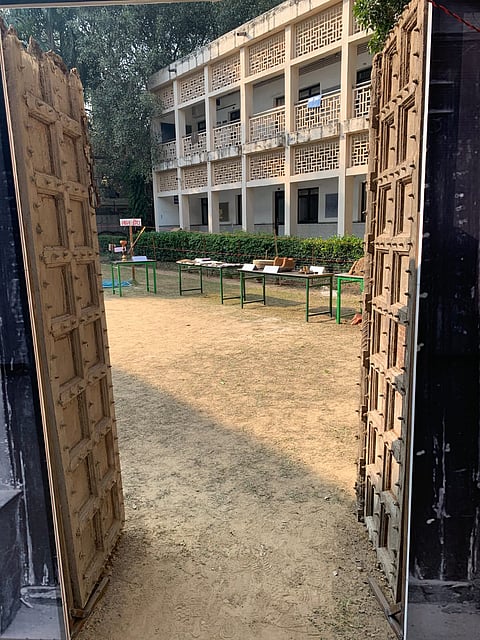
That tension, rooted yet constantly reshaped, is what the university’s Department of Urban Studies set out to document through months of fieldwork in Katwaria Sarai. The findings were showcased at the recently held exhibition, Delhi Dehat: Tracing Memory, Space and Transition in Delhi’s Urban Villages at the university’s Karampura campus.
Katwaria Sarai’s identity has been sculpted by paying guesthouses and coaching centres. Waves of land acquisition for institutions like IIT Delhi and government housing after the partition, tightened the space between ancestral homes; it turned the village into a corridor of rentals and commercial storefronts that cater to a constantly shifting student population.

What lines beneath
Historically named after Ran Singh Katwaria, Katwaria Sarai was known for its wells and produce carried to Daryaganj. Today, the tomb that once stood alone has become a parking corridor, a stark symbol of compression. Yet community memory persists. Local lore recalls a grazier, Harsukh, guided by Baba Gorakhnath to excavate idols of the kul devta. The temple that rose there continues to anchor neighbourhood pride, with the Ram Talab pond and two annual fairs of wrestling and ritual still drawing crowds.
“We were trying to understand how people adapt when the city swallows the village but does not fully accept it,” said Professor Tokas of Ambedkar University, who supervised the project. Four student teams explored history, economy, governance, religion and culture to understand communities that are no longer rural but not fully urban either. One group used satellite imagery to track land use from 1985 to 2015 and found a dramatic rise in built-up area and a steep fall in vegetation.
“This was three and a half months of sustained field visits and archival work,” said student researcher Poorti Arora. “These were self-sustaining communities, but land acquisition squeezed them in.” Exemption from municipal by-laws has created a landscape where panchayat ghars and oral traditions sit beside PG accommodations, coaching centres and chawls. Local landlords have benefited from the shift to a rent based economy, but migrant tenants struggle with basic facilities. Katwaria Sarai currently has just one public toilet.
Identity shifts
As coaching hubs move elsewhere, the student population is declining and the quick turnover of residents is changing the neighbourhood’s social rhythm. Cultural life has also shifted. “Jeans have replaced traditional attire, while traditional Jat food has been replaced by fast food,” said researcher Anuja Dey Bhowmik. “Festivals continue, but quieter .” Migrant inflow has softened caste markers yet weakened the choupal, the traditional village meeting place that once defined community life. It has become like a village functioning as a transit camp for the metropolis.
Through maps, films and interviews, Delhi Dehat shows how Delhi’s growth did not only take farmland. It overtook markers of identity, memory and belonging. “Urbanisation is not just a story of buildings,” Prof. Tokas said. “It is a story of people and the memories they refuse to lose.”
Those memories remain, sometimes hidden, sometimes stubbornly visible. Like the Lodhi era tomb at the entrance of Katwaria Sarai, squeezed by the city yet still reminding Delhi of its rural past. These villages are not leftovers from history. They are the unseen foundations of the city, breathing beneath the concrete.