
S Keerthivas
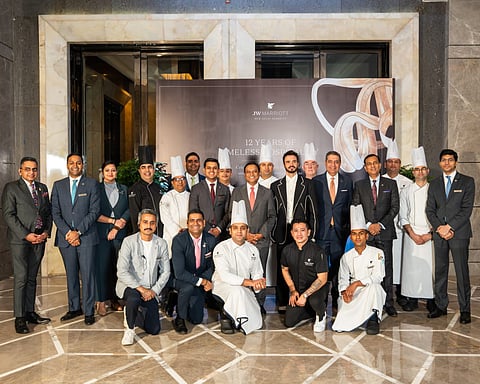
The JW Marriott, New Delhi Aerocity, marked its 12th anniversary recently with a dinner that celebrated not only a hotel’s milestone but also a deeper meditation on origins, where heat, light, and flavour intertwine. Every dish seemed to trace the journey of sunlight, from the field to the plate.
The evening, curated by chef Caique Tizzi, was titled ‘The Art of Harvesting the Sun’, an exploration of how nature, fire, and time converge to create food.
Tizzi, an Italian, was born in Brazil. He now lives in Berlin. Not surprisingly, he has a multicultural sensibility that reflects in his cooking. His food feels like a crossroads of continents—the passion of Latin America, the style of Italy, and the experimentation of Berlin’s art scene. The result is a cuisine that is as thoughtful as it is sensory.
The dinner theme drew inspiration from the proverb, “Agriculture is the art of harvesting the sun.” For Tizzi, this saying captures the eternal cycle between nature and nourishment. “Cooking, to me, is the art of harvesting fire,” he said. “Fire is the beginning of the universe, the first act of transformation. As humans, we project the sun’s power through fire to create food.”

Before he found the kitchen, Tizzi dreamt of becoming an artist. “Food was always important to me,” he recalled. “In 2009, I started a project space in Berlin with a group of artists called Ajaguado. I used to cook for everyone, and somewhere along the way, I began to see food differently as an extension of art itself.”
That realisation became a turning point. Cooking moved from hobby to vocation, merging his creative instincts with his love for sensory experience. “Cooking is a living language,” he said. “While cuisines may differ, the act of cooking connects cultures. It’s how people communicate without words.”
Berlin became his canvas; a city that, as he put it, exposed him “to so many kinds of food and ways of thinking”. He began blending Brazilian ingredients, Latin flavours, and Italian techniques with global inspirations. “That’s when I found my voice,” he said. “Taste is very underestimated. I like to invoke a kind of synesthesia through flavour and make people see taste and feel colour.”
The dish, Avocado with Sundried Tomato Jam, Sumac, and Isot, for instance, with its vivid hues and sauce was an encounter between fire and sunlight.
The avocado was gently charred over barbecue flames, its creamy texture infused with a whisper of smoke. The sundried tomato jam, slow-cooked and sweetened by the sun, carried the depth of caramelised sugar — like lava formed from dried fruit. Smoked chipotle added warmth, while sumac and isot brought balance through citrus brightness and earthy spice.
Every element spoke of transformation—from the sun’s drying heat to the fire’s final kiss. The result was a dish that felt both rustic and refined, where smoke, sweetness, and acid merged in quiet harmony. It captured Tizzi’s belief that nature itself is the artist, and cooking is its interpretation. The dish glowed with restraint — deliberate, balanced, and layered.
The Tuna Crudo and Passion Fruit Aguachile was another standout dish
Elegant in restraint, this plate embodied the quiet dialogue between sunlight and earth. The dish unfolded as a study in texture and tone, where the tender fish met a sauce that anchored the dish. The passion fruit aguachile brought both brightness and depth, its acidity softened by the fruit’s sweetness and a whisper of chili heat.
Beneath the charred surface, the sauce glowed tangy, golden-red, alive. Each element spoke of transformation, where fire, fruit, and sea converged in harmony — serene, deliberate, and radiant in simplicity.
The evening culminated in two structural desserts: a sun-inspired installation and a hybrid composition of chiffon cake, duke de leche, coconut miso and fruit leather, anchored by luminous ice sculptures symbolising the sun’s energy.
Cooking the universal language
For Tizzi, food is both the origin and the art. “Nature is precious,” he said. “Humanity has always adapted to it, learned from it, and taken what it needs. Using the sun as a cooking language is my way of honouring that connection.”
In his eyes, the sun is the alchemist of nature that turns raw into ripe, green into gold, sugar into caramel, and fruit into leather. “It is an experience,” he said.
“I find immense privilege in cooking here,” he added, reflecting on his Delhi experience. “Indian food is one of my favorites—the spices, the depth, the diversity. I often use Indian flavours because they carry vastness; they tell stories in heat and colour.”
As the night drew to a close, the guests at the JW Marriott left with more than just full bellies. There was a shared realisation that cooking, when viewed through an artist’s eye, is a conversation between the elements.