
As technology and fast fashion reshape how cloth is made and used, Latitude 28 invites viewers to look beyond how textiles continue to carry memory, history and emotion beyond their practical use. ‘Lived-In Skin: Textile as Armour as Memory’, on view at the Defence Colony gallery till June 25, brings together works by Sri Lankan artist Sabeen Omar and Indian artists Meenakshi Nihalani and Anshu Singh. Through weaving, stitching, embroidery and material reconstruction, the exhibition examines how cloth can act as a storehouse of personal memories, traditions, and histories.
Mumbai-based artist, Meenakshi Nihalani presents ‘The Sun Followed Me’, a series full of family stories. She remembers how, during Partition, her maternal and paternal families migrated from what is now Pakistan and settled in Agra and Baroda. Alongside their belongings, they carried memories and recipes that were passed down through generations and became lasting family traditions.
Nihalani remembers watching the women prepare pickles every summer, and listening to the bedtime stories her grandmother told. Yet much of their experience and many of those tales remained unrecorded. She preserves those bits of history through hand-stitched, colorful cotton and jute textiles. She also uses pickle jar motifs to represent memories and the traditions passed between generations. "I wanted to talk about migration indirectly," she told TMS. "Recipes, objects and stories carry history from one generation to another."

Memory in material
Omar uses discarded materials such as old garments, cardboard, bed sheets and other everyday objects collected from family members to transform them into carriers of memory. She recalled how objects such as her grandmother's wedding dress or a dupatta would be carefully preserved and passed down through generations. "I was interested in the idea of using these thrown-away garments and then asking how you infuse them with the value of an heirloom."
Many of the textiles in her works once belonged to members of her family. Clothing worn by her mother and sisters, wrapped in a bedsheet from her home are exhibits—she has turned them into artwork “as a portrait of her family”. In the ‘Is Sorrow the True Wild?’ series, she explores grief through embroidered surfaces, using materials such as handkerchiefs, gold leaf and beads. The patterned textiles and tiny beads create richly textured, abstract compositions that immediately draw the viewer's eye.
Looms, labour, legacy
While Omar's work focuses on preservation and personal memory, Singh turns her attention to the textile industry and the risks faced by the weavers. Born in Ballia, Uttar Pradesh, and trained in weaving and tapestry at Banaras Hindu University, Singh’s works are heavily inspired from her experiences growing up around her mother's boutique in Varanasi, where she was introduced to weavers and handloom communities from an early age.
"Fabric has always been part of my life," she said. "I grew up watching how cloth was made and how nothing was wasted." Her practice uses recycled materials including jute, old saris and factory waste. These materials are cut, washed, turned into thread and crafted into new forms, highlighting ideas of repair and sustainability.
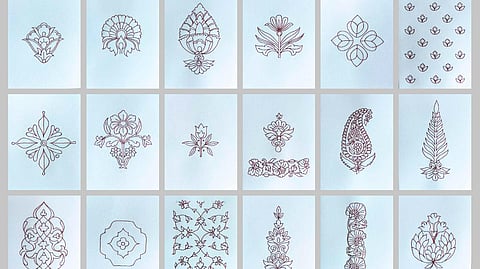
Singh also pointed out the invisibility of women's labour within the textile industry. During her research for this project in Banaras, Singh observed that while women often contribute through dyeing, embroidery and support work, they are rarely seen operating the looms used to produce the city's famous brocades. One of her works, ‘Gulistan’, draws from an archive of brocade designs preserved by her uncle. The patterns, traditionally woven into textiles, are embroidered onto Fabriano paper, creating a record of design traditions that are increasingly under threat.
‘Wire and Veins’ is another work in which Singh weaves a brocade using red thread and recycled copper wire from power looms. According to Singh, the copper wire points to technology encroaching on the weaving industry and the resulting risks faced by weavers.
Through their works, Omar, Singh, and Nihalani show how cloth can preserve histories that are often overlooked. Their creations turn textiles into witnesses, bearing reminders of labour, grief, and concern for future generations.