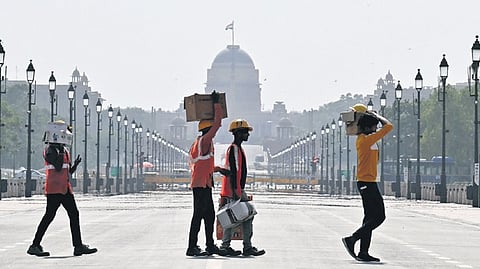

The persistent heat wave blazing across the country is raising serious concerns. The Indian Meteorological Department (IMD) issued a red alert on Monday, warning that a severe heat wave will persist in Punjab, Haryana, Chandigarh, Madhya Pradesh and Gujarat for the next 5-6 days.
The IMD calls it a severe heat wave when temperatures are at least 6.4°C above normal or the maximum temperature crosses 47°C for two consecutive days. The scorching conditions in the North pushed up peak power demand to 230 GW last Saturday, a figure unheard of on a weekend; and the average demand in May is expected to be 235 GW. Last year, the peak power demand in May was 221 GW.
The electricity demand in Delhi touched 7,572 MW on Monday, the highest ever for May. These are all pointers to heat conditions deteriorating with each passing summer.
The prolonged heat wave has already extracted a heavy toll. The hills of Uttarakhand have become dry tinder and have been devastated by forest fires.
The Supreme Court, admonishing the state government, noted that these fires had reached the outskirts of the once salubrious hill station of Ranikhet. Besides wildfires, livestock and crops are wilting and dying. There is a cascading effect down the economic chain. More than 75 percent of farm workers are impacted, leading to lower productivity and job losses; and ultimately to a shortage of animal fodder and foodgrains, and high food prices.
We have a health emergency at hand, too, with increasing cases of dehydration, cramp and heat stroke. Last year, as many as 232 people succumbed from heat wave conditions. It must be realised that these conditions are nothing but a manifestation of climate change. While the battle to lower the temperature at Earth’s surface is a global effort, immediate short-term measures need to be taken. While we hope the advancing monsoons will keep to the schedule, arrangements for providing drinking water and shade shelters at schools and public spaces will reduce incidences of dehydration.
Broader policies must include reversing the denudation of forests and planting trees on a war footing, as progressive cities like Singapore have done. Architecturally, too, the government must encourage environmentally sustainable construction that lowers the use of air-conditioning. We must also move faster to a less dense, greener planning formats with more open spaces.
