
A recent ‘landslide’ and ‘waterfall’ at a deep excavation site in Bengaluru, where an ambitious skyscraper is due to come up, has become the subject matter of much social media mockery and a political slugfest.
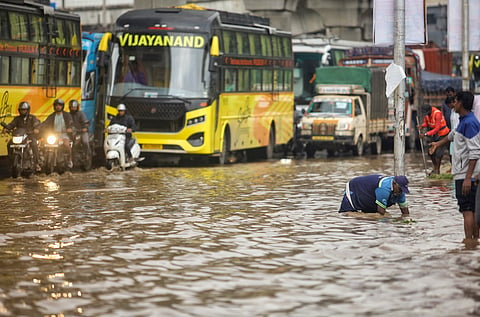
It is this image that appears to signify all the IT City has become - a flooded mess where residents struggle to save homes inundated with sewage water, salvage ruined vehicles in basements, where tractors rescue schoolchildren on waterlogged roads, and people are considering selling their dream homes and leaving.
The trail of destruction left by two days of continuous rain has battered the glitzy image of ‘Brand Bengaluru’ and become fodder for politicians who are pointing fingers at each other: the opposition BJP-JDS is poking fun at the Congress for failing the city, while the ruling party is blaming the previous regime.
Ministers are pointing to London, New York, and Dubai being similarly inundated during flash floods. Home Minister G Parameshwara said “we cannot send the rain back into the sky”, while Deputy CM D K Shivakumar claimed “it is not possible to control nature”.
No doubt, urban flooding is a global phenomenon, with the Chennai and Mumbai disasters still fresh in memory. But this is not the time for politicking - when citizens are in distress, and marooned without basic facilities like clean water and electricity, the political classes should help mitigate their woes.
What has brought Bengaluru to such a sorry pass is a combination of poor planning, a realty boom, and complete disregard for the city’s natural topography.
The role of political and civic authorities in the wanton destruction of the lake ecosystem is beyond doubt; wetlands have been acquired and tech parks built on them, blocking the water flow. Layouts have mushroomed around them and got the stamp of legality from the civic authorities. It is no wonder the city is inundated.
There are other causes too: drains blocked with plastic and garbage, encroached stormwater drains, and untrammelled concretisation.
For a couple of decades, even as Bengaluru’s infrastructure has been groaning under sudden growth and a population influx, politicians have held up mirages of a future Singapore, the latest being tunnel roads connecting the far corners of the city.
No doubt, there has been much progress by way of connectivity and such aspirations are healthy, but when the city barely stays afloat during rain and subways have seen drownings, it would be wise for our leaders and city planners to first set ills right.
