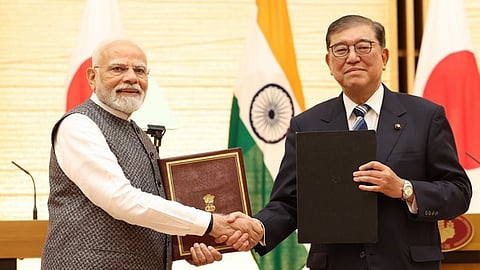

Built to trust and building to last, the India-Japan partnership is entering its most defining decade. Prime Minister Narendra Modi’s recent visit to Japan for the annual summit was more than just another diplomatic event. It was a strategic signal.
The two countries are deepening a relationship that has remained steady, incident-free, and mutually reinforcing over the decades. This is happening in a world of growing geopolitical fragmentation, technological divides and supply chain uncertainty.
A ‘Joint Vision for the Next Decade’ sits at the heart of this summit. It is a forward-facing blueprint based on eight pillars: economic security, advanced technology, clean energy, resilient mobility, innovation ecosystems and grassroots partnerships between states and prefectures.
Japan’s decision to double its private investment target in India to ten trillion yen ($67 billion) is more than just capital. It’s a commitment reflecting Japan’s strategic wager on India’s scale, capability, and its future role in shaping a global order that suits Japan. Economic security now defines the partnership.
The launch of a structured dialogue between Japanese and Indian industry federations marks a turning point, aligning the public and private sectors to accelerate action in strategic domains, including critical infrastructure and emerging technologies.
Semiconductors are a flagship area. Joint initiatives have moved from concept to production. These include a new chip packaging plant in Gujarat, collaborations with Indian technology institutions, and research partnerships aimed at creating a semiconductor ecosystem rooted in Indian soil yet globally integrated.
The strategic alliance between Tokyo Electron and Tata Electronics adds depth. It signals Japan’s confidence in India’s manufacturing future. In parallel, Japan’s funding for a startup-focused fund in Tamil Nadu will boost innovation in areas from microchips to clean technology. The two countries are also cooperating more on rare earths and mineral security. This provides a crucial hedge against geopolitical risks in energy transition supply chains.
In digital infrastructure, the partnership is evolving from a buyer-seller relationship to a co-developer one. Whether in fifth-generation mobile networks, Open Radio Access Networks, or advanced communication systems, Japanese technology and Indian scale are converging to co-create the digital infrastructure of tomorrow. This summit was not about sentiment and economic strategy. India and Japan are crafting a forward-looking alliance that aligns economic ambition with strategic foresight; it must remain engineered for the future.
