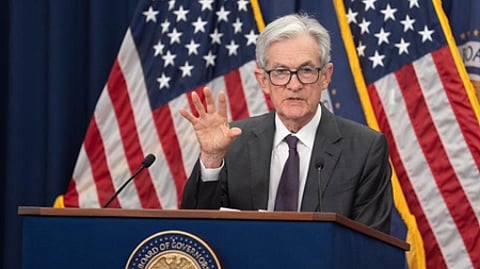

The Federal Reserve on Thursday reduced US benchmark interest rates by 0.25 percentage points to 3.5-3.75 percent, the lowest in nearly three years. However, the central bank’s third cut of the year drew policymakers’ dissent amid a weakening job market, America’s inflation trajectory, and the state of its economy. The dot plot—the Fed members’ individual expectations on rates—indicated one more reduction in 2026 and 2027 each, before the federal funds rate hits the longer-run target of 3 percent. In other words, the hawkish move carried caution flags about inflation favouring higher rates, while those with a dovish stance argued for lower rates to support the labour market. On balance, the central bank signalled a tougher road ahead, indicating that further easing may be put on hold.
The rate cut comes at a sensitive time for the Fed, with Chair Jerome Powell nearing the end of his second term and intrigue building up over his successor. Besides, Fed officials had to decide with incomplete data, thanks to the US federal government’s six-week shutdown. Nonetheless, the rate cut led to a rally in the American and Asian stock markets; even the Sensex and the Nifty ended three-day losing streaks to close 426.86 and 140.55 points higher, respectively, on Thursday. On the US economy, the Fed raised the 2026 GDP growth projection to 2.3 percent, while it pegged inflation above its 2 percent target until 2028. As for the effect of tariffs, Powell noted it would be a one-time shift in price levels and not an ongoing inflation stirrer.
A Fed rate cut often makes global liquidity cheaper, softens the dollar, and lowers the yield of US Treasuries. As dollar investments become less lucrative, foreign portfolio investors explore emerging markets like India. The upside of such capital inflows is that it offers relief to the rupee, eases pressure on the Indian markets, and opens up space for the RBI to reduce rates again. Indian markets have been bleeding despite the recent rate cut, thanks to persistent foreign portfolio outflows, rupee depreciation, and uncertainty over the India-US trade deal. The emerging markets, particularly India, can benefit from a softer dollar, though volatility cannot be ruled out amid the swirling geopolitical uncertainties.
