
Bangladesh is approaching its February 12 parliamentary elections amid growing instability, highlighting the fragility of the interim government led by Nobel laureate Muhammad Yunus. This has raised significant concerns in New Delhi regarding security, extremism and regional stability. An expected stabilising transition following the ouster of Sheikh Hasina in August 2024 has instead resulted in recurring violence, political paralysis and rising anti-India sentiment. Once projected as a regional success story, the country is now experiencing its most volatile period since last year’s student-led uprising.
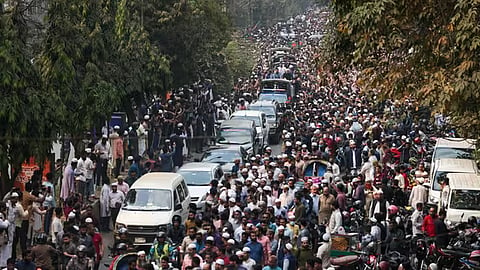
The immediate cause of the unrest was the death of Sharif Osman Hadi, a prominent youth leader of the July movement and a candidate in the upcoming elections. Violent protests in Dhaka and other cities followed his death, with attacks on media outlets, public infrastructure and Indian diplomatic premises. The interim government declared a day of mourning and urged citizens to resist ‘mob violence by fringe elements’, but that has not reassured the public about its ability to maintain order. The crisis has exposed the limitations of Yunus’s administration, which has struggled to manage rival political groups, Islamist hardliners and street mobilisation. The Awami League, excluded from the elections, has threatened to continue its protests, raising concerns that the electoral process may be disrupted.
For India, the implications are immediate and significant. Protesters attacked the Indian Assistant High Commission in Chattogram, and visa centres in Rajshahi and Khulna were closed. Anti-India slogans and graffiti are now more frequent. Since Hasina’s departure to New Delhi, India has become a political target, with some protest groups framing the unrest as resistance to ‘Indian hegemony’.
New Delhi is increasingly concerned about the rising extremist narratives and deteriorating security for religious minorities. Recent communal violence has direct implications for India’s border security. Strategically, India faces heightened competition from China and Pakistan. Beijing has increased engagement with all segments of Bangladesh’s political landscape, including Islamist groups. India, meanwhile, maintains formal relations with the interim government and has reiterated its support for a ‘democratic, stable, peaceful and inclusive Bangladesh’. Efforts to advance connectivity and energy cooperation, such as power transmission from Nepal through India, continue. However, people-to-people relations are weakening, and goodwill is declining. The unresolved issue of Sheikh Hasina’s stay in India adds further diplomatic complexity. The outcome of the February elections will have lasting effects on India’s security and regional interests.
